

OPINION | Hannes Nagel: Tallinn Hospital would be a target
An opinion piece by Hannes Nagel, Head of the Crisis Research Centre, was published in the Estonian daily newspaper Postimees, raising the question of how Estonia should plan its strategic civilian infrastructure in a changing security environment. Using the Tallinn Hospital project as an example, Nagel examined the extent to which military threats, comprehensive national defence and the continuity of essential services are taken into account when planning major public sector investments.

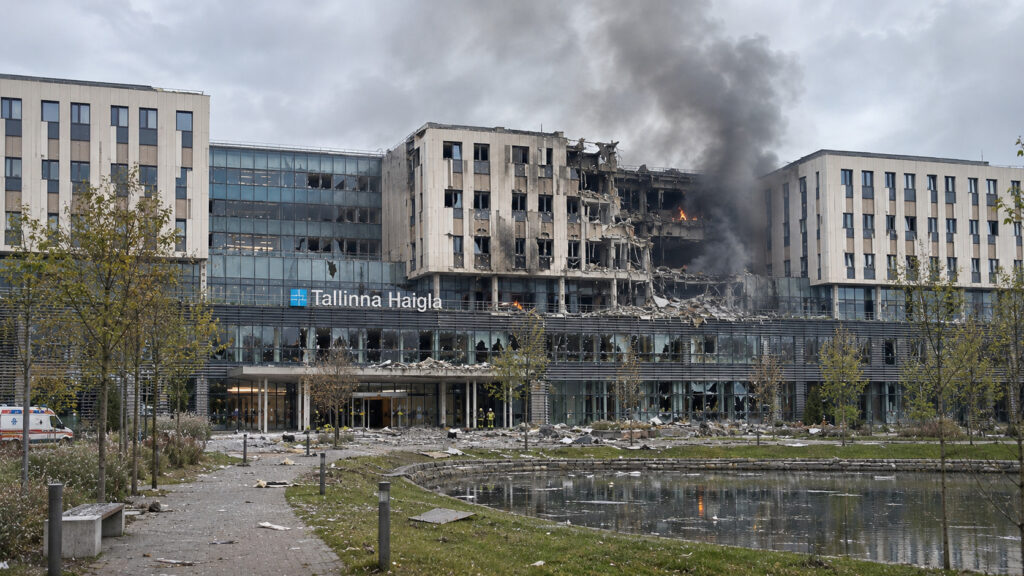
In short, after 24 February, it is unthinkable that we should put all our eggs in one basket and then place that very basket on a potential front line. In the defence of Greater Tallinn, crucial urban battles would take place in precisely the area of Lasnamäe where this colossal hospital complex is planned. These are matters that must be discussed in peacetime, notwithstanding NATO’s growing military presence and deterrence capabilities in our region. Whilst this is undoubtedly essential, the planning of strategic civilian infrastructure remains our own responsibility. Should we get it wrong, we will face formidable challenges in the event of a military crisis.
From the perspective of comprehensive national defence, an inevitable question arises: what would become of Tallinn Hospital in the event of a Russian attack? We know from Ukraine that targeting hospitals and other civilian infrastructure – including nurseries, power stations, shopping centres and public transport hubs – forms part of the aggressor’s deliberate military strategy. The objective is to terrorise the population and undermine both its willingness and its ability to resist.
There is no reason to believe that Tallinn would fare any differently. Quite the contrary: what we are witnessing in Ukraine is likely to reflect a strategy that our hostile neighbour would employ against its other neighbours, given the opportunity. The Estonian Defence League has repeatedly spoken of its three-tier defence model, in which those delivering, reinforcing and sustaining defence capabilities each have a role to play. If the hospital ceases to exist as a result of missile strikes or aerial bombardment, it will be of little use to anyone – unless, of course, it becomes another Azovstal and performs miracles.
The other undeniable fact is that Tallinn needs a new hospital, but in the form of a strategically dispersed hospital estate. Doggedly pressing ahead with the project in its current form simply defies common sense. The fact remains that the hospital was designed for a world that no longer exists. The original plans did not even provide for bomb shelters, let alone take into account the possibility of carpet bombing. Tallinn undoubtedly needs a new hospital, but one whose facilities are strategically dispersed. Only then can it retain its capacity to reinforce and sustain national defence.
Pressing ahead regardless is simply not a sensible course of action, irrespective of how many millions were spent on designing Tallinn Hospital before 24 February. We have reached a point at which the Ministry of Defence must be involved in the approval process for strategic infrastructure projects. Tallinn is home to more than 445,000 residents, with some of its districts more populous than entire cities elsewhere. All these people need access to modern healthcare, but not in the form of a single mammoth hospital. Not in peacetime, and most certainly not in wartime. Carrying on as before is no longer an option.
🟠 This op-ed has been published in Postimees outlets both online and in print, on 4 July 2022 (126/7769, p. 10). Photos: A visualisation of the Tallinn Hospital complex based on the original project plans.
🔺The use, distribution, modification or publication of the text and images is permitted only with the prior written agreement of NGO Crisis Research Centre; any unauthorised use is prohibited.
Jaga postitust: