

INTERVIEW | Anne-May Nagel: There’s more growing in our gardens than food
Since May 2026, the Crisis Research Centre has been exploring how community gardens and educational gardens can contribute to urban food security, cooperation between city residents and crisis preparedness through its EDENTallinn project. In her interview with Sirp, project manager Anne-May Nagel reflected on the wider role of urban gardens, looking beyond food production to consider what they can offer cities and the people who live in them.
It often feels as though we are surrounded by crises, some more visible than others. Crisis preparedness is also discussed almost daily, although usually in terms of what supplies people should keep at home and where they should take shelter. Is linking urban gardening with resilience a new way of looking at things?
“That rather depends on the period we are talking about and the type of crisis we have in mind. If we look at the Crisis Research Centre’s work and preparations for a situation similar to the war in Ukraine, then yes, I think it is fair to say that urban gardening offers a relatively fresh perspective in Estonia, one that has not previously received enough attention in this particular context.”
Urban gardens come in all shapes and sizes, from a couple of raised beds in a company courtyard to extensive allotments. Some are simply places to grow flowers, while others host workshops, community working bees and evenings around the campfire. There are also allotments dating back to the Soviet era, traditionally intended for growing produce rather than bringing people together for the sort of communal activities we see today. Does the type of garden make a difference when it comes to resilience?
“I would actually start with a different question: what kinds of crises, and at what levels, can urban gardens realistically help us address? One aspect is the infrastructure – all the tangible things you find in a garden, such as raised beds, plots of land, greenhouses and so on. But I am much more interested in the relationships and the people who spend time in these gardens. When we think about crisis preparedness, it is important to see a garden as a place that brings together people who might otherwise never have crossed paths. Cities can be rather lonely places, and gardening can help counter that isolation. That matters enormously when it comes to preparing for crises.
I think we should see urban gardens as platforms. I have learnt a great deal from, and been inspired by, the Kopli 93 community garden. Karin Kruup from Tallinn University of Technology, as project manager, and Ave Timberg from Tallinn City Government have achieved a tremendous amount there through a research project, really bringing the garden to life. I have been fortunate enough to be part of that team.
From the outset, we saw the garden as a means of bringing about broader change in society, rather than an end in itself. The story of Kopli 93 is particularly interesting because its early years coincided with the beginning of the COVID-19 pandemic. At the time, indoor events were subject to strict restrictions – face masks, limits on attendance and so forth. Outdoors, however, there was considerably more freedom. The courtyard at Kopli 93 provided an opportunity to turn the circumstances of the crisis into something positive: offering people an enjoyable activity and, importantly, bringing them together.
That is just one example of how something positive for a community can emerge from a crisis. And gardening can also provide a foundation for dealing with other challenges. Take mental health, for instance. Why shouldn’t urban gardens also be places where we address issues like that? Or consider another important issue in Tallinn – integration. Gardens bring together city residents from very different backgrounds, speaking different mother tongues.”
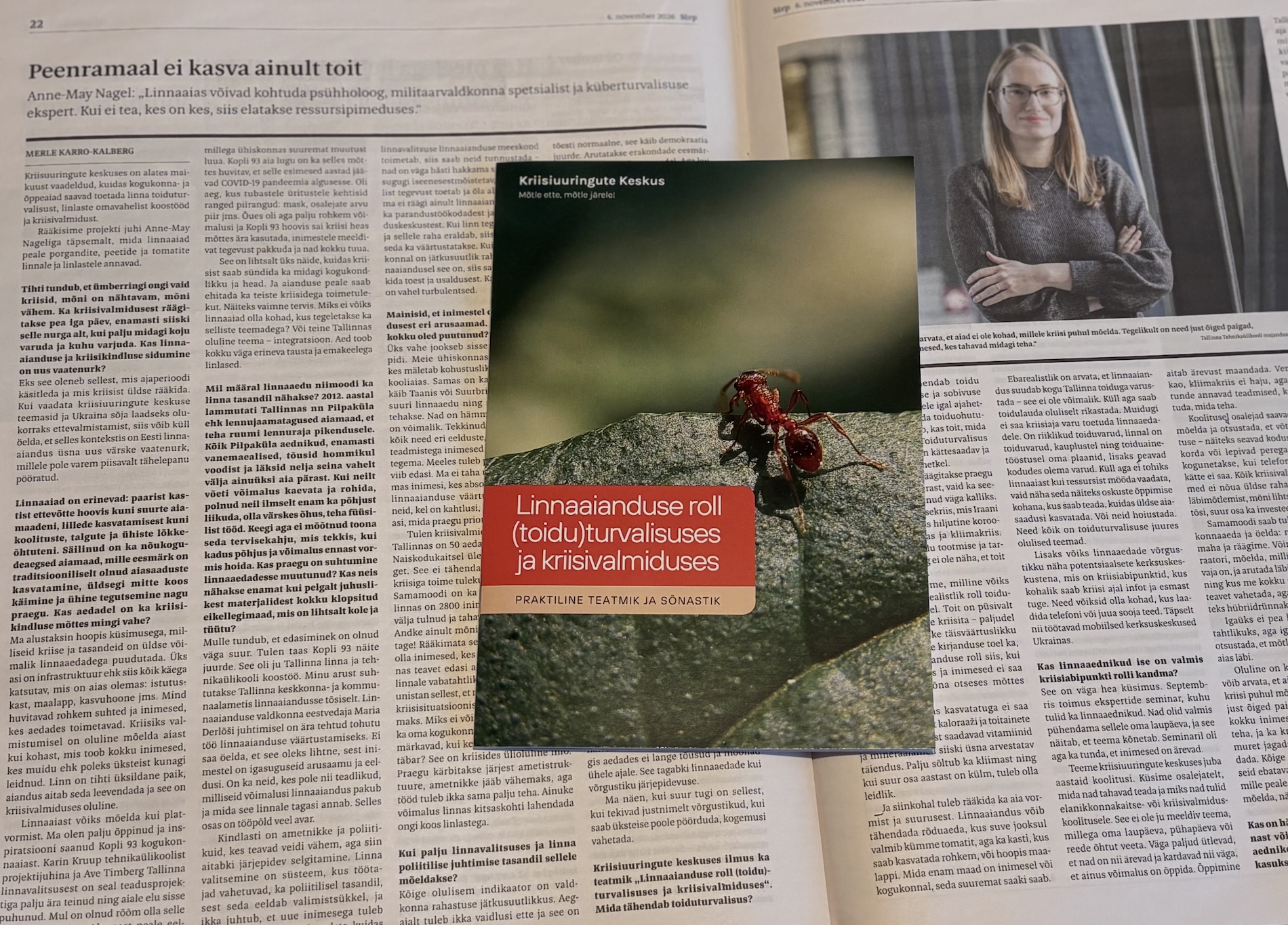

Anne-May Nagel: “Some might think gardens are the last places to consider in a crisis. In fact, they are exactly the right places, because they bring together people who want to take action.”
To what extent is this wider understanding of urban gardens reflected at city level? In 2012, Tallinn’s so-called Pilpaküla allotments, located behind the airport, were demolished to make way for an extension of the runway. The gardeners there, most of them elderly, had a reason to get out of bed every morning and leave their homes simply because they had their gardens to tend. Once they lost the opportunity to dig and weed, they presumably also lost a reason to get moving, spend time outdoors and engage in physical activity. Yet nobody measured the impact on their health when that opportunity to stay active disappeared. Have attitudes towards urban gardens changed since then? Are they now seen as something more than unattractive, troublesome patches of no man’s land cobbled together from whatever materials happen to be available?
“I think there has been enormous progress. Let me return to the example of Kopli 93. That was a collaboration between the City of Tallinn and Tallinn University of Technology. In my view, urban gardening is taken seriously by Tallinn’s Environmental and Municipal Services Department. Under the leadership of Maria Derlõš, who heads the city’s urban gardening initiatives, a tremendous amount of work has gone into raising awareness of the value of urban gardening. That is not to say it has been easy, because people have all sorts of perceptions and expectations. Some are simply less aware of the opportunities urban gardening offers and what it gives back to the city. There is still plenty of work to be done on that front.
There are undoubtedly officials and politicians who are less familiar with the subject, but that is where continuous explanation and engagement come in. City government is a system in which people come and go, including at the political level, as part of the electoral cycle. Inevitably, there are times when you have to start explaining things all over again to someone new. But looking at the work being done by the city’s urban gardening team, they deserve considerable credit. They have done an excellent job. We should not take it for granted that a city is willing to support and invest in activities of this kind. And I am not talking only about urban gardening, but also repair workshops and circular economy centres. When a city supports an activity and allocates funding to it, that is a clear indication that it sees value in it. If an area of activity has sustainable funding, as urban gardening does, then we can reasonably speak of support and trust, even when the political climate is occasionally rather turbulent.”
You mentioned that people have different perceptions of urban gardening. What sorts of attitudes have you encountered?
“There is something of a generational divide. In our society, we have a generation that remembers being required to work in school gardens. At the same time, there is another generation that visits Denmark or the United Kingdom, sees extensive urban gardens and discovers what people are doing with them. They are astonished by what is possible. We therefore find ourselves in a situation where people with very different assumptions, life experiences and levels of knowledge need to work together. What matters is remembering that discussion helps us move forward. I find it difficult to believe that there are people who genuinely see no value whatsoever in urban gardening. There are certainly those who question whether it should be a priority at the moment.
Coming back to crisis preparedness, Tallinn has 50 gardens and 2,800 gardeners. The Women’s Voluntary Defence Organisation, Naiskodukaitse, has 4,000 members across Estonia. That does not mean everyone has the same skills when it comes to coping with crises, and the same applies to urban gardens. But here are 2,800 people in Tallinn who have made the effort to leave their homes because they want to do something. Give them a subject to get their teeth into and some training! Not to mention the fact that these people could pass information on through their own social networks and potentially volunteer to help the city. My ambition is to see them become better equipped to act in a crisis. Why couldn’t urban gardeners also become the eyes and ears of their communities, noticing when someone is struggling or finds themselves in difficulty? That sort of information is absolutely vital during a crisis. At present, public-sector structures are increasingly being cut back. There are fewer officials, yet the amount of work that needs doing remains much the same. The only realistic way to address many of the challenges facing a city is to work alongside its residents.”
How much thought is being given to this within the city administration and at the political leadership level?
“The most important indicator is the long-term sustainability of funding for the sector. Disagreements arise from time to time, of course, and that is perfectly normal. It is part and parcel of democracy. Political parties debate their priorities, and day-to-day politics inevitably plays a role. But if we look at how long urban gardening has received support from the city’s budget, and the extent of that support, it would be difficult to argue that the subject is being ignored or considered unimportant. As long as the funding continues, we cannot reasonably claim that nobody is listening or that the value of urban gardening is not understood. The support is there.”
Who are the 2,800 people who come together in Tallinn’s urban gardens?
“They are people from all walks of life. Why does someone take up gardening? There are all sorts of reasons. Many do not have a country home or anywhere else they can garden and get their hands in the soil. Some come to ease their loneliness. Others want to show their children how carrots grow. Some use gardening to relieve stress. Life is rather demanding at the moment. There is a great deal of pressure at work, and the news is full of negativity. You do not necessarily have to be in the middle of a major crisis to need some relief. People also come to gardens to escape everyday worries and enjoy doing something together, even if they would not necessarily describe it in those terms. Eventually, going to the garden simply becomes a pleasant habit.”
Most urban gardens are run by community volunteers. They get things started, bring people together through their enthusiasm, but eventually they become tired. They have jobs to go to, children arrive, and everyday life demands their attention. Is this model sustainable?
“Fifty gardens in Tallinn is already quite a substantial number, but that does not mean there could not be more. Inevitably, some gardens will fade away while others spring up. Some go through quieter periods, while others are particularly active. That is a natural part of people organising and doing things together. There can sometimes be a fear that something might disappear, but I would encourage people to see this as a natural process.
We should also look beyond a purely market-based understanding of how things work. Running a garden is a considerable undertaking, largely dependent on voluntary effort, with little or no financial reward. There will be better times and more difficult ones. The important thing is that the ups and downs do not happen simultaneously across every garden. That is what helps ensure the continuity of urban gardens as a network. I have seen just how valuable these networks become when people can turn to one another, share experiences and offer mutual support.”
The Crisis Research Centre has also published a guide entitled The Role of Urban Gardening in Food Security and Crisis Preparedness. What exactly does food security mean?
“Food security means ensuring that everyone has access to sufficient and appropriate food at all times. It should not be confused with food safety. Food safety concerns whether the food we consume is safe to eat. Food security, on the other hand, is about whether food is available, accessible and suitable for people’s needs at any given time.
Food security is being discussed increasingly not only because of crises, but also because food has become so expensive. Most recently, there has been the ongoing fuel crisis resulting from the war in Iran, alongside the recent coronavirus pandemic, the war in Ukraine and the climate crisis. All of these affect food production and supply systems, and there is little indication that food is going to become cheaper.
In the guide, we explore what a realistic contribution from urban gardening to food security might look like. Food remains expensive even without a sudden crisis, and many people already struggle to afford a nutritious, balanced diet. Drawing on the research literature, we also examined what role urban gardening might play in a serious crisis in which people are literally unable to obtain food from shops.
Although produce grown in urban gardens cannot meet a person’s entire daily calorie and nutritional requirements, it can still provide a valuable supplement in terms of vitamins and minerals. Much also depends on the climate. When a substantial part of the year is cold, a certain amount of ingenuity is needed.
This is also where the type and size of the garden matter. Urban gardening might mean a balcony garden producing ten tomatoes over the summer, a raised bed capable of yielding more, or a larger plot of land. The more growing space an individual or community has, the greater the potential harvest.
It would be unrealistic to imagine that urban gardening could feed the whole of Tallinn. That simply is not possible. But it can make a meaningful contribution to the variety and nutritional value of people’s diets. Naturally, emergency food supplies cannot depend on urban gardens. There are national food reserves, municipal food stocks, contingency arrangements within shops and the food industry, and households must also maintain their own emergency supplies. Nevertheless, we should not overlook urban gardens as a resource. They can serve as places where people acquire practical skills, learning how to grow produce in the first place, for example, or how to preserve and store it. These are all important aspects of food security.
Beyond that, we could see the network of urban gardens as potential resilience hubs – local crisis support points where residents can obtain information and basic assistance during an emergency. They could be places where people can charge their phones or have a warm cup of tea. This is precisely how mobile resilience hubs operate in Ukraine.”
Are urban gardeners themselves ready to take on the role of providing crisis support?
“That is a very good question. In September, we held an expert seminar which urban gardeners also attended. They were prepared to devote their Saturday to the subject, which tells us that it matters to them. At the same time, there was a noticeable sense of anxiety among participants.
At the Crisis Research Centre, we have been delivering training for years. We ask participants what they want to learn and why they have chosen to attend a civil protection or crisis preparedness course. After all, these are hardly cheerful subjects to spend a Saturday, Sunday or Friday evening discussing. A great many people tell us that they feel so anxious and frightened that learning seems to be the only way forward. Acquiring knowledge helps them manage that anxiety. Russia is not going to disappear, and neither is the climate crisis. But knowing how to respond and what to do can give people a greater sense of security.
Training gives participants the opportunity to think things through and decide to take responsibility. That might mean organising their emergency supplies at home or agreeing with their family where to meet if they cannot contact one another by phone. Not every preparedness measure costs money. Some simply require a bit of thought, others an agreement between people, although admittedly many do involve financial investment.
The same approach could be taken in a community garden. People could come together and say: right, let’s set aside some time and have a proper conversation. We could buy a generator, consider what supplies we might need and work out how information would be shared and where we would meet if, for example, a hybrid attack disrupted internet access.
Not everyone needs to become a crisis volunteer, but everyone could at least make the decision to think these things through, both at home and in their garden.
Mental health is another important consideration. Some might think gardens are the last places to consider in a crisis. In fact, they are exactly the right places, because they bring together people who want to take action. And during a crisis, people need something to do, opportunities to share their concerns and constructive ways of managing their anxiety. What matters most is recognising the potential of less obvious spaces – these so-called ‘third places’ that might not immediately spring to mind when we think about crisis preparedness.”
Are there good examples from Tallinn, Ukraine or the Nordic countries where a garden or a network of gardeners has genuinely proved useful during a crisis?
“Speaking of Tallinn, I would return to the COVID-19 pandemic. I would venture to suggest that being stuck at home quickly became unbearable for many people. We also have the mental health statistics: the negative consequences of the restrictions and life during the pandemic are still with us. Enjoyable activities outdoors can themselves be a form of crisis support.
In Ukraine, we work with a wonderful NGO called Poruch. Our Ukrainian colleagues tell us that mental health is a major concern in Ukrainian cities – and I am talking about areas away from the front line, not those directly affected by ground fighting. The war has gone on for so long that, alongside the physical destruction caused by drone attacks on buildings and the constant disruption of essential services, people’s mental health has also become increasingly fragile.
When you are living through a war and have little to do beyond worrying, any kind of practical, hands-on activity can help. I think that is precisely why gardens became so important to people during the coronavirus crisis. They offered an opportunity to switch off from everything else, potter about outdoors with other people and take their minds off their worries.
Films can give us the impression that a crisis is all non-stop action, with things constantly flying through the air and explosions going off somewhere. But a real crisis can involve a great deal of waiting. Waiting to be evacuated. Waiting for things to improve. Waiting for events to resolve themselves somehow. Waiting for spring to arrive so that it will no longer be quite so cold.
Ukrainians have been living like this for several years now, and somehow everyday life has to continue. As we are speaking in the pages of Sirp, it seems particularly appropriate to talk about cultural life as well. Why do theatres and libraries remain open in Ukraine during the war? Why are concerts still being held? Precisely to preserve as much normality as possible, to keep hope alive and to maintain the understanding that there is something worth defending. That despite everything, there is a valuable culture which people consider important enough to sustain even in wartime. It is also about protecting mental health, because that helps sustain morale.
Crisis preparedness is not just about rockets, artillery shells and mines laid along the border. It is much broader than that. It also encompasses culture, urban gardens and heritage.”
What should local government officials in Estonia, and perhaps politicians too, take away from the guide? What should they be paying attention to?
“Urban gardening is worth recognising as an opportunity to build communities and develop ways of addressing local problems. That does not mean the work will be quick or easy. But simply identifying challenges together with residents, discussing them and agreeing on the first steps forward is already significant progress. In an average urban garden, there might be someone who already works in crisis preparedness, a nurse, a psychologist, someone with a military background or a cybersecurity expert. There might also be a chef with experience of catering for large numbers of people, or someone capable of organising childcare during a crisis. But if nobody ever asks who is willing to do what, what skills the group collectively possesses, or even raises the subject of crisis preparedness, then we remain blind to the resources already available within our communities.”
Photos and video: Article introducing the guide and promotional material (Crisis Research Centre, 2026).
🔺The use, distribution, modification or publication of text and images is permitted only with the prior written consent of the NGO Crisis Research Centre. Any unauthorised use is strictly prohibited.
Jaga postitust: