
CRISIS LENS | Russia’s Failed Blitzkrieg in Ukraine Through the Lens of Military Terminology
Following the annexation of Crimea, Vladimir Putin first issued a threat against the rest of Ukraine in the final days of August 2014: ‘… if I want to, I can take Kyiv in two weeks!’1 – a clear reference to lightning warfare. But why was Russia contemplating a blitzkrieg and a rapid campaign of conquest in the first place? Where does the term Blitzkriegoriginate, what does it mean and what does it seek to achieve?
The term Blitzkrieg first appeared in print in 1935 in the German military journal Deutsche Wehr2 and was used only once more before the outbreak of the Second World War. In 1938, First Lieutenant Braun published an article entitled ‘Blitzkrieg’,3 in which he described the concept of assault troops (German: Stoßtruppen) capable of inflicting tactical shock on enemy positions. This was a relatively novel approach for its time, as was General Heinz Guderian’s Achtung – Panzer!,4 published a year earlier in 1937. Blitzkrieg was not part of everyday German vocabulary until 25 September 1939,5 when the American magazine Time mentioned the term in an article. More specifically, the article6 discussed the Wehrmacht’s lightning campaign that had crushed Poland. Thus was born the legend of lightning warfare, the significance of which was soon recognised by Nazi propaganda.
Although the definition of blitzkrieg is rather broad and numerous contemporary experts have attempted to conceptualise it, I shall confine myself here to a couple of the more distinctive interpretations. General Paul Armengaud, the French military attaché in Warsaw, for example, described it as a German system ‘… combining dive bombers and tanks to break through enemy lines and penetrate deep into the rear …’.7 Robert M. Citino, Professor of History at Eastern Michigan University in the United States, characterised it as a German phenomenon that ‘… draws upon the traditions of German military history. A doctrine involving the extensive use of mechanised units (including air units) to defeat, pursue and destroy large enemy forces within two to four weeks.’8,9
Putin apparently intended to undertake something similar in Ukraine to Nazi Germany’s Fall Weiß (Case White), launched against Poland on 1 September 1939. German forces reached the outskirts of Warsaw by 8 September, and the capital was captured on 28 September of that year. Russia’s invasion of Ukraine, however, has, to put it mildly, failed to deliver the success that had been anticipated and promised.10 Quite the contrary, the invasion has been marked by confusion and horrific war crimes, through which the Russian Federation has manoeuvred itself onto the same level as Nazi Germany. Admittedly, the ‘special military operation’ (Russian: специальная военная операция), which cannot legally be called a war in Russia, continues. This is widely regarded as an attempt to save face, as it is abundantly clear that the lightning campaign has failed and fallen far short of what was hoped for, perhaps drawing inspiration from the German Wehrmacht.
At this point, it is worth returning to Guderian’s (1937) Achtung – Panzer!, whose message is relatively straightforward and remains relevant during Russia’s aggression against Ukraine in 2022. Admittedly, tanks, anti-tank warfare, military doctrines and armed forces as a whole have changed considerably. Nevertheless, the principle governing the employment of armoured forces articulated by Guderian in 1937 remains timeless and is likely to remain so for the foreseeable future. Namely, the proper (!!!) employment of tanks and their supporting armoured vehicles is essential to the conduct of future warfare. It appears that the Russian General Staff has neglected to study this work with sufficient care. Although precise and verified figures for Russian military equipment losses are not yet available, the numbers are nevertheless unexpectedly high, even when considering only visually documented cases.11
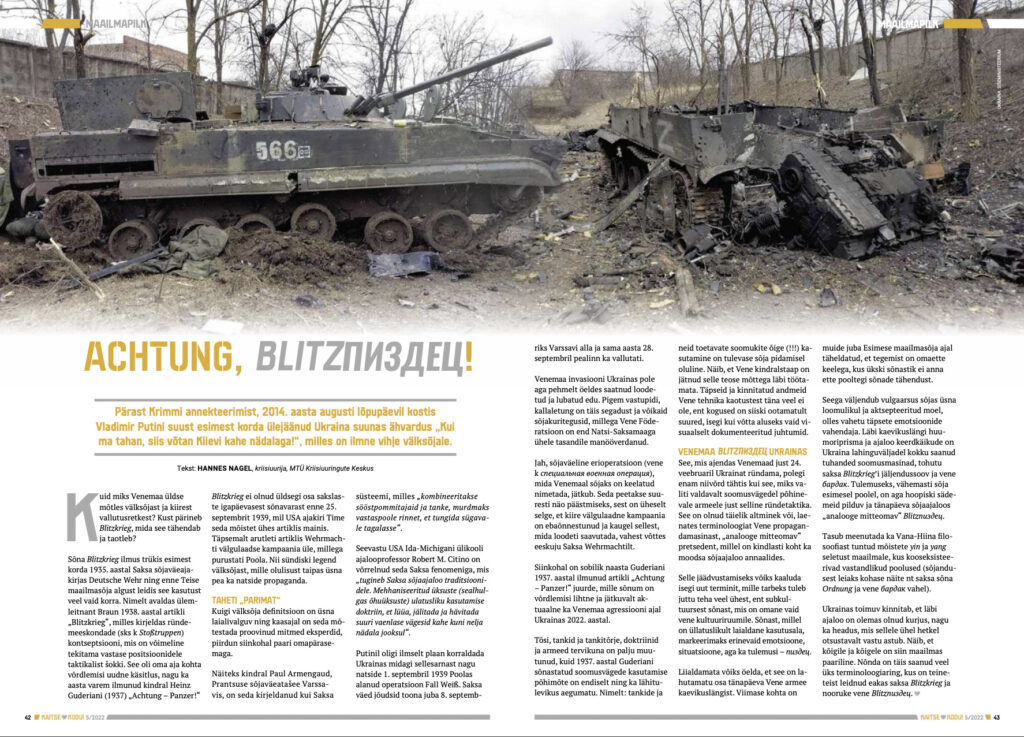
The inaugural article in the series was published in the June 2022 issue of the Estonian Defence League’s military magazine Kaitse Kodu!
Russia’s Invasion of Ukraine Gives Rise to a New Term
What prompted Russia to attack Ukraine on 24 February is no longer as important as why this particular offensive tactic was chosen for an army predominantly reliant on armoured forces. It has been an outright failure or, to borrow the terminology of the Russian propaganda machine, an ‘unprecedented’ development that will undoubtedly earn its place in the annals of modern military history. To capture this development, one might even consider coining a new term. This requires introducing another word, albeit one rooted in a subculture peculiar to the Russian-speaking world. It is a word with a surprisingly wide range of uses, conveying various emotions, situations and outcomes – пи*дец.
Without exaggeration, it could be described as an integral part of contemporary Russian military trench slang. As early as the First World War, trench slang was observed to constitute a language of its own, with no dictionary providing the meaning of even half its words.¹² Vulgar language thus finds a rather natural and accepted place in warfare, serving as a direct and precise means of conveying emotions. Through the prism of trench humour and the twists and turns of history, thousands of armoured vehicles, an overwhelming desire to emulate the German Blitzkrieg, and Russian бардак (chaos and disorder) have converged on the battlefields of Ukraine. The result, at least as far as the initial phase of the war is concerned, has instead been a spectacular, spark-flying and, in the annals of modern military history, ‘unprecedented’ Blitzпи*дец.
Finally, it is worth recalling the ancient Chinese philosophical concept of yin and yang, which explains the world through the coexistence of opposing forces (a fitting military example might be the contrast between the German Ordnung and the Russian бардак). Events in Ukraine reaffirm that throughout history, evil has existed alongside goodness, which at some point rises decisively to confront it. It seems that everyone and everything in this world has its counterpart. Thus, another terminological circle has been completed, with the venerable German Blitzkrieg and the youthful Russian Blitzпи*децhaving finally found one another. Congratulations to the happy couple!
🟠 This analysis was also published in the Estonian Defence League’s military magazine Kaitse Kodu! (5, pp. 42–43) and on the Delfi news portal on 22 June. Photo: A burnt-out Russian BMP-type infantry fighting vehicle (Crisis Research Centre, 2022).
🔺The use, distribution, modification or publication of text, video and images is permitted only with the prior written consent of the NGO Crisis Research Centre. Any unauthorised use is strictly prohibited.
Sources
2 von Schwichow, W. 1935. Die Ernarungswirtschaft als Wehrproblem, 02.05.1935, Deutsche Wehr, VIII(39), pp. 257-260.
12 [Anon.], 1917. Trench Terms. And their meanings. 10.08.1917, The Listening Post, 27, p. 10.
Jaga postitust: