
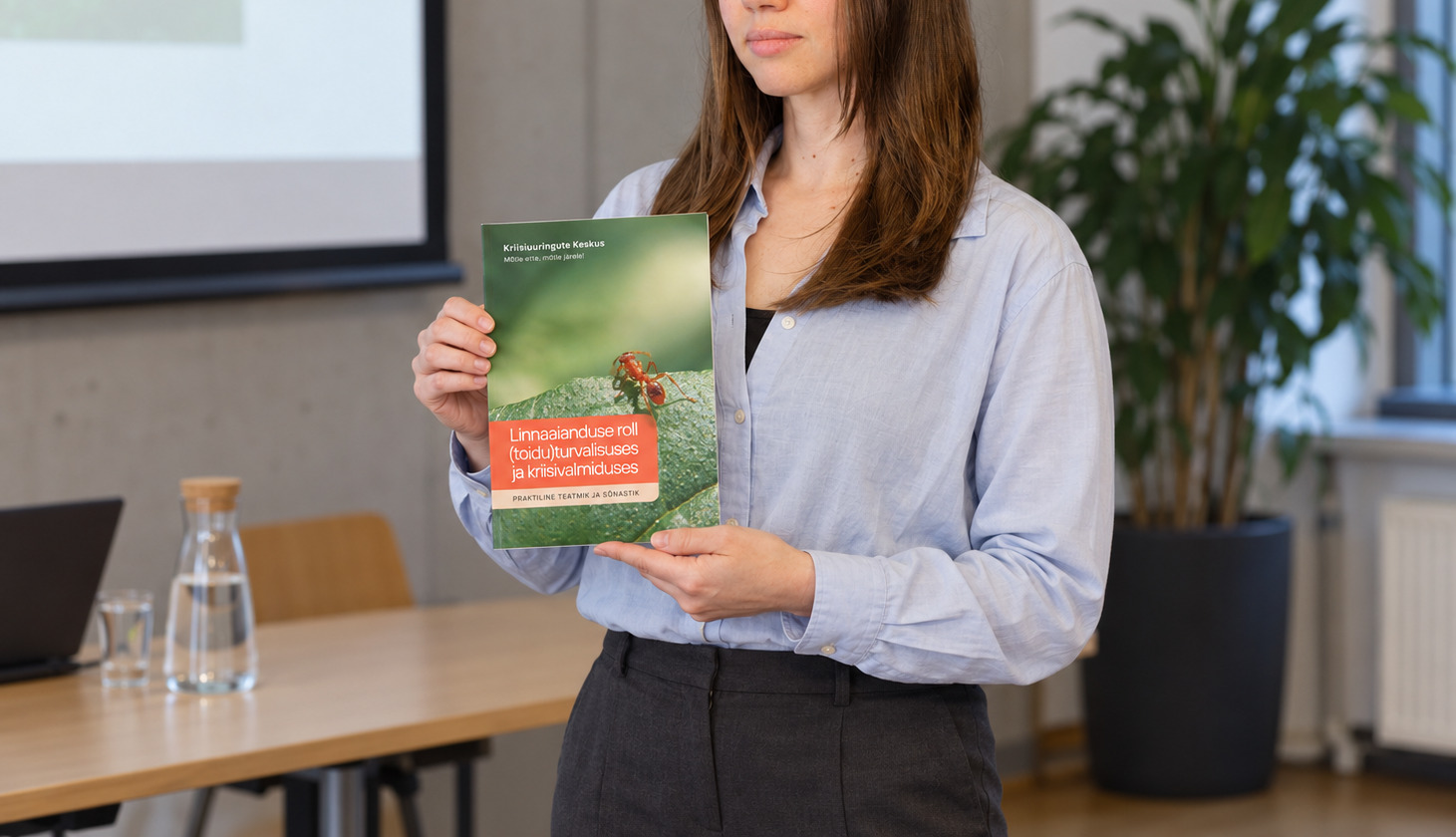
New publication explores the role of urban gardening in food security and crisis preparedness
The handbook brings together academic research, experience from Tallinn and discussions from the EDENTallinn expert seminar held on 19 September 2026. In addition to the main text, the publication includes an extensive glossary that helps clarify concepts related to urban gardening, food security and crisis preparedness, and avoids the confusion that can arise when terms with different meanings are used interchangeably.
“We wanted to produce a handbook that is as practical as possible – one that does not promise more from community gardens than they can realistically deliver, while at the same time recognising their considerable potential. A garden is not simply a place where food grows. It can also be a place where skills, relationships, knowledge and people’s willingness to take action can grow,” said Anne-May Nagel, co-founder of the Crisis Research Centre and project manager of EDENTallinn.
Why discuss urban gardening in the context of crisis preparedness?
The day-to-day functioning of cities depends on many systems and supply chains that often go largely unnoticed under normal circumstances. Food reaches shops, water comes from the tap, and most essential goods and services remain continuously available. During a disruption, however, these dependencies quickly become visible. The starting point of the EDENTallinn project was not the idea that a city should begin feeding itself through community gardens. Quite the opposite: one of the central questions was what community and educational gardens can realistically contribute, and where the limits of their potential lie.
“We are not suggesting that community gardens could replace Tallinn’s food supply in a crisis. The more interesting question is what capacity already exists in these places before a crisis occurs – who knows how to grow food, who knows the local area, who can bring people together, and how this knowledge can be retained and passed on,” Nagel explained.
Among other topics, the handbook examines why a community garden, an educational garden and an urban farm are not the same thing; how food availability, food access and food security differ; how seasonality affects what gardens can do; and why the mere existence of a garden does not automatically amount to crisis preparedness. At the same time, this is neither a gardening manual nor a crisis-response guide. The handbook is intended above all to help communities, gardening organisers, educational institutions and local decision-makers ask more precise questions and take a more systematic view of the resources already available.
⬆️ Read more and join the conversation.
A glossary for those who want to understand the topic in depth
A substantial part of the publication is devoted to a glossary. It explains a number of key concepts frequently used in discussions of urban gardening, food systems and crisis preparedness, but whose meanings can vary considerably depending on the context.
“When we use terms such as resilience, empowerment or food security, we need to be clear about what we are actually measuring. Otherwise, it is very easy to attribute significance to a small-scale activity that is not supported by the data or by its actual capacity. The glossary is intended to help make these distinctions clearer,” Nagel said.
🟠 The publication also considers what Tallinn could do next. We will not reveal all the answers in this news story – those interested can find them in the publication itself. You can also read more about the seminar here. The project is co-funded by the City of Tallinn and the Tallinn Urban Environment and Public Works Department together with the Crisis Research Centre.
🟢 PS! The Role of Urban Gardening in Food Security and Crisis Preparedness is also available in print in a limited number of copies and can be ordered for the cost of postage HERE.
Images: The Crisis Research Centre’s new practical publication on community and urban gardens (Crisis Research Centre, 2026).
🔺The use, distribution, modification or publication of the text, photographs and videos is permitted only with the prior written consent of the NGO Crisis Research Centre; unauthorised use is not permitted.
Jaga postitust: