
A crisis does not start with a headline: CRISIS LENS looks beneath the surface
The Crisis Research Centre is launching the publication of the analytical CRISIS LENS series on its website. Each article in the series focuses on a country, region, crisis-related phenomenon, or broader security-policy development that helps explain how crises emerge, evolve, deepen, or become embedded in long-term international tensions.
Crisis Lens is not a daily news section. Its focus is slower and more in-depth analysis: why a conflict, political confrontation, humanitarian crisis, technological risk, or state vulnerability develops into a crisis; which historical, political, and societal factors intensify it; and what can be learned from such cases for understanding, preventing, and managing crises.
Over the years, our researchers have published dozens of analytical overviews on geopolitical crises, security-related phenomena, and key issues in international politics. Several of these analyses have previously appeared in print in the Estonian Defence League’s magazine Kaitse Kodu!. Since March 2026, the Crisis Research Centre has been bringing these analyses systematically to its website, accompanied by specially created illustrations.
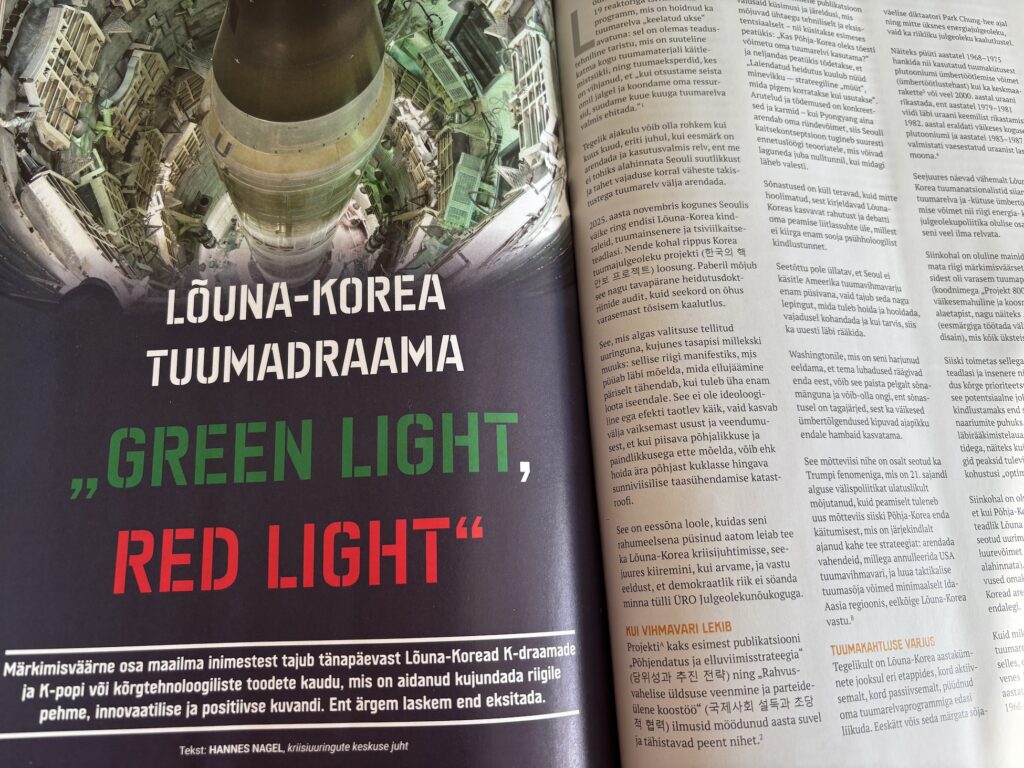
In the 2026 Crisis Lens overviews, we examine, among others, South Korea, Yemen, Iran, and Palestine and Israel. These cases are connected by different but comparable crises and challenges: questions of nuclear policy and deterrence, state fragility, regional power dynamics, the intertwining of military and civilian dimensions, humanitarian consequences, and long-term conflicts whose effects extend far beyond national borders.
The broader aim of the series is to show that crises do not emerge out of nowhere. They are often the visible moment of longer-term developments: the convergence of political choices, historical traumas, social tensions, regional power struggles, resource scarcity, or institutional weakness. For this reason, understanding crises requires more than following the latest event or headline. It requires attention to the trajectory of the crisis, the logic of the actors involved, visible and hidden vulnerabilities, and the ways in which one crisis can feed into others.
Crisis Lens is intended for readers who want to understand more than individual events. The series provides background knowledge, analytical context, and a crisis research perspective on how uncertainty, power, violence, societal resilience, and political decisions intersect.
For the Crisis Research Centre, publishing the series on its website is a step towards making its long-standing analytical work more widely accessible. Talking about crises should not be limited to reacting during a crisis. Crises need to be understood before, after, and in between — when they are still taking shape, when their consequences become embedded in society, or when similar patterns begin to appear elsewhere. Crisis Lens helps to identify these patterns. Enjoy reading!
Photo: An article from the Crisis Lens series in printed form (KRUK, 2026).
Jaga postitust: