KRAKO | Building crisis preparedness through collaboration in Haabersti
Haabersti is home to more than 52,000 people across twelve neighbourhoods. From a crisis preparedness perspective, this means a wide range of living environments, each with its own vulnerabilities. Within the same district, there are both vulnerabilities and valuable resources that may prove essential during a crisis. The question is whether we are aware of them before a crisis strikes.
Unfortunately, we cannot prevent every crisis, but we can reduce the likelihood of a difficult situation escalating into a disaster. Having emergency supplies or a single crisis plan is not enough. Genuine preparedness depends on whether contingency arrangements are in place, whether people know how to use them, whether key contacts have been established and whether different stakeholders are accustomed to working together. Effective crisis preparedness requires information, skills and support to be connected, alongside a willingness to think things through before a crisis occurs.
It is particularly important to consider what cooperation means at the local level. Take an apartment building, for example: crisis preparedness does not end at your own front door. If communications fail, the water supply is disrupted or residents need to evacuate the building at short notice, questions quickly arise that cannot be answered by individual emergency supplies alone. Such situations call for solutions at the level of the apartment owners’ association. It is essential to understand what responsibilities fall to the association and what individual apartment owners must manage themselves. Neither communities nor apartment owners’ associations can replace the state or emergency services. However, when a crisis begins, local residents are already on the ground and know their surroundings better than anyone else.

This is why the Crisis Research Centre is implementing the KRAKO crisis network project in Haabersti, funded by the City of Tallinn and the Tallinn Municipal Police Department, with the support of the Haabersti District Administration. The project brings together people who want to take a more systematic approach to crisis preparedness in their district and contribute to civil protection as volunteers. The free training sessions aim to connect residents who are keen to get involved, share ideas and take practical action in their local area, laying the groundwork for a local crisis preparedness network. The training is the starting point of this process, not the end goal.
KRAKO is also a research project. Both the Crisis Research Centre and the city are keen to gain a better understanding of what motivates people to contribute to crisis preparedness in their neighbourhoods, what forms of cooperation they consider realistic and what helps maintain connections beyond the training sessions. These are practical questions, because an effective network cannot simply be created by decree. It develops when people share an understanding of their roles, have opportunities to get to know one another and see a reason to continue working together.
If you are interested in making your community better prepared for crises and would like to play a more active role in strengthening local resilience, you can find further information and register here.
The KRAKO project is implemented by the Crisis Research Centre. The project is co-funded by the City of Tallinn, the Tallinn Municipal Police Department and the Crisis Research Centre.
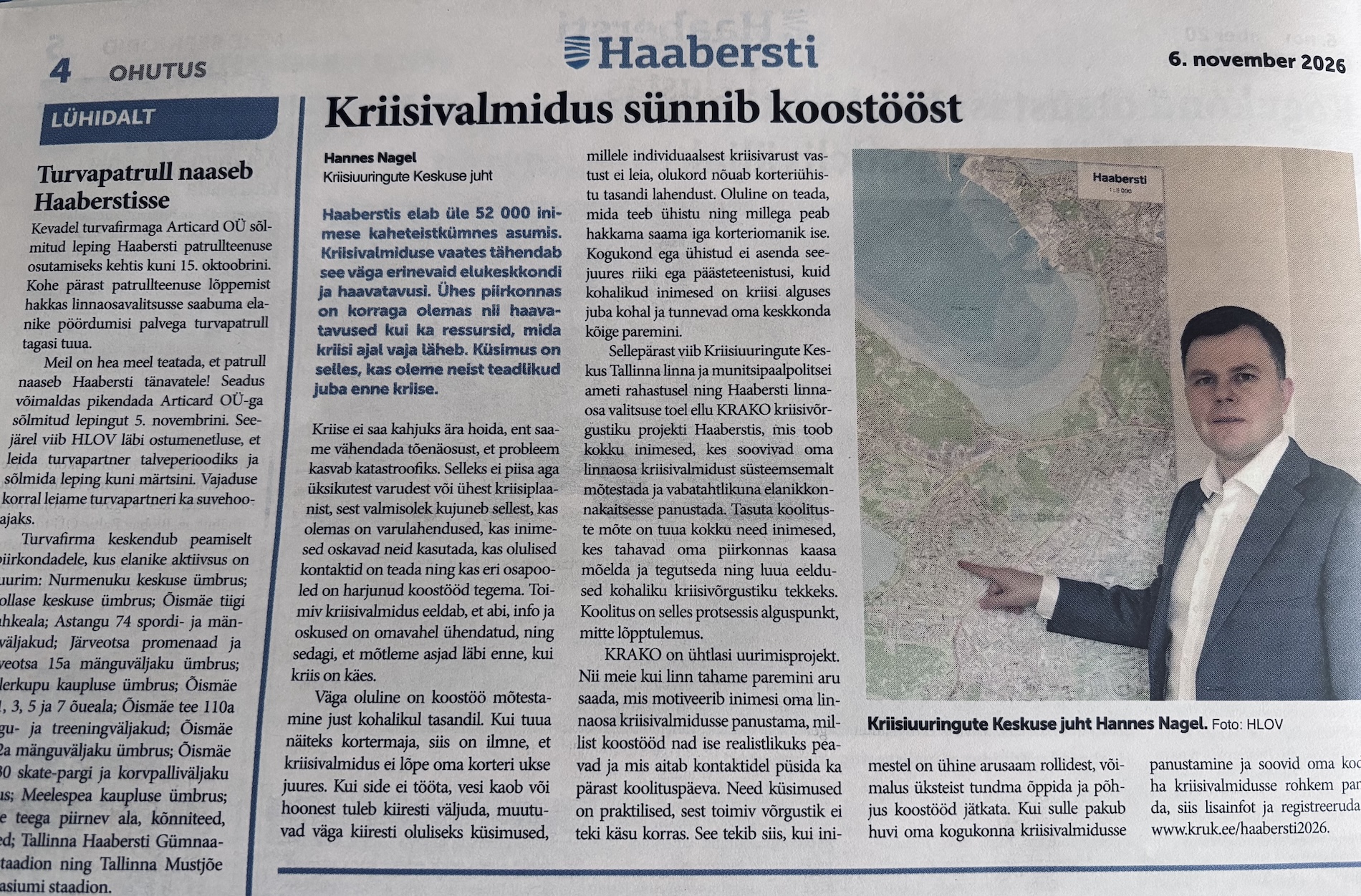
Photo: Advertisement in the Haabersti district newspaper (Crisis Research Centre, 2026).
🔺The use, distribution, modification or publication of text and images is permitted only with the prior written consent of the NGO Crisis Research Centre. Any unauthorised use is strictly prohibited.
Jaga postitust: