
CRISIS LENS | South Korea’s nuclear drama: “green light, red light”
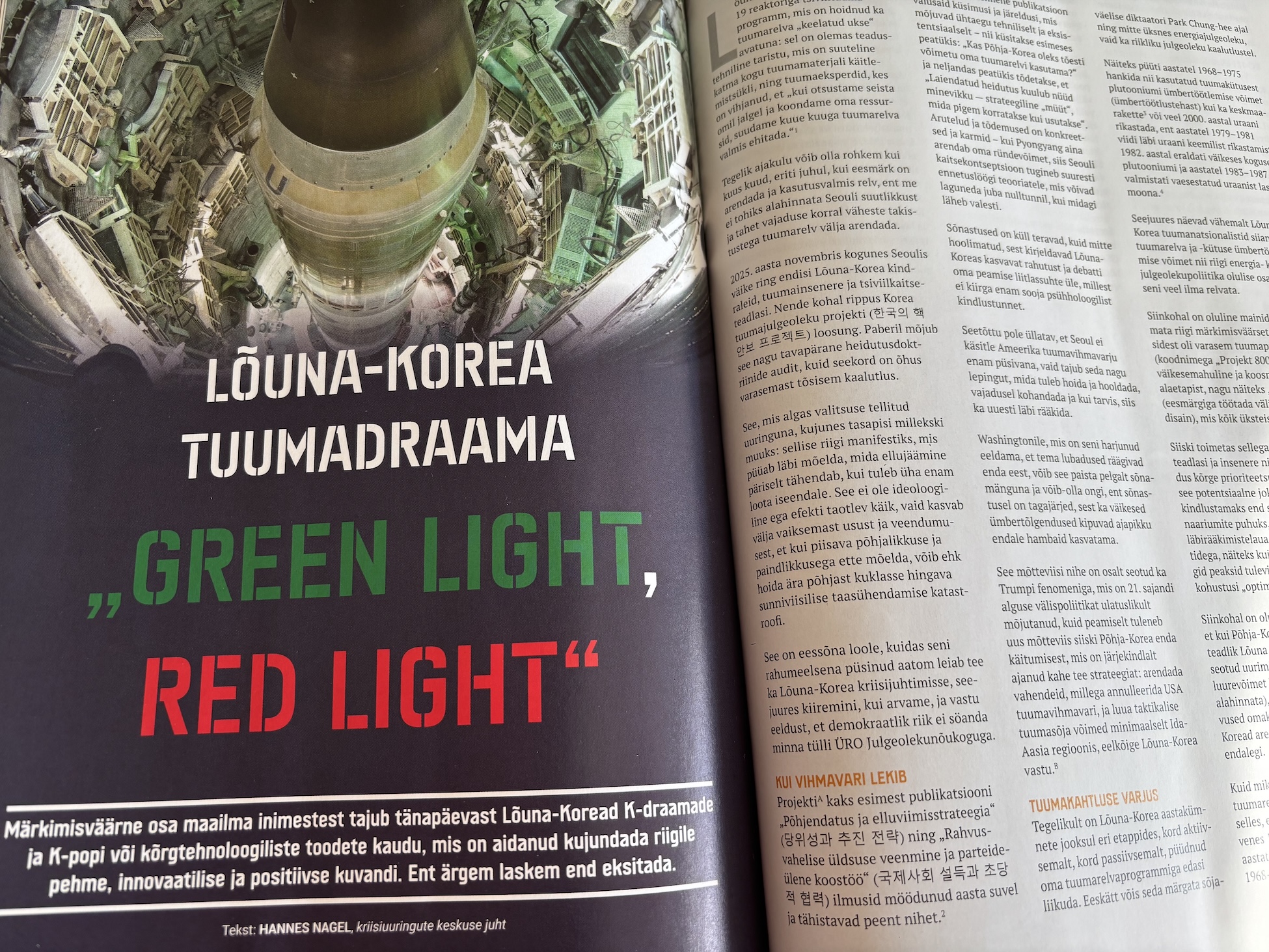
In this instalment of the Crisis Lens series, we take a look at a country with a significant civilian nuclear program comprising 19 reactors. South Korea has the scientific and technical infrastructure capable of covering the full nuclear material handling cycle, as well as nuclear experts who have suggested that “if we decide to stand on our own feet and concentrate our resources, we could build a nuclear weapon within six months.”¹ The actual timeline may be longer than six months, especially if the goal is to develop a deployable and operational weapon. Still, Seoul’s capacity and willingness to develop nuclear weapons with relatively few obstacles, should it deem this necessary, should not be underestimated.
In November 2025, a small circle of former South Korean generals, nuclear engineers and civil defence scholars gathered in Seoul. Above them hung the banner Korea Nuclear Security Project (한국의 핵안보 프로젝트). On paper, it looked like a conventional audit of deterrence doctrines. This time, however, there was a more serious question in the air. What began as a government-commissioned study gradually turned into something else: a manifesto for a state trying to think through what survival really means when it must increasingly rely on itself.
This is not an ideological or theatrical move. Rather, it grows out of a quieter belief that if one thinks far enough ahead, and flexibly enough, it may still be possible to prevent the catastrophe of forced reunification breathing down from the North. It is the preface to a story about how the atom, long kept peaceful, may find its way into South Korea’s crisis management faster than we expect — and against the assumption that a democratic state would not dare to fall out with the UN Security Council.
The project’s first two publications,A “Justification and Implementation Strategy” (당위성과 추진 전략) and “Persuading the International Community and Building Bipartisan Cooperation” (국제사회 설득과 초당적 협력), appeared last summer and mark a subtle shift.² The first publication, for example, poses painful questions and draws conclusions that feel both technical and existential. Its first chapter asks: “Would North Korea really be unable to use its nuclear weapons?” In the fourth chapter, it states that “extended deterrence now belongs to the past — a strategic ‘myth’ repeated more than believed.” The discussions and conclusions are concrete and harsh: as Pyongyang continues to develop its strike capabilities, Seoul’s defence concept still rests heavily on theories of pre-emptive strike, which could collapse already at hour zero if something goes wrong.
Although the wording is sharp, it is not reckless. It describes a growing unease in South Korea and a debate about its central alliance relationship, which no longer radiates the same psychological reassurance. It is therefore not surprising that Seoul no longer treats the American nuclear umbrella as permanent, but increasingly sees it as an agreement that must be maintained, serviced, adapted when necessary and, if needed, renegotiated.
For Washington, long accustomed to assuming that its promises speak for themselves, this may look like mere wordplay — and perhaps it is. But wording has consequences, because even small reinterpretations tend, over time, to grow teeth. This shift in thinking is partly linked to the Trump phenomenon, which has profoundly shaped early twenty-first-century foreign policy. Yet the new mindset is driven above all by North Korea’s own behaviour: its consistent pursuit of a two-track strategy, developing capabilities to neutralise the US nuclear umbrella while building tactical nuclear warfare options at least in the East Asian region, and primarily against South Korea.B

In the shadow of nuclear suspicion
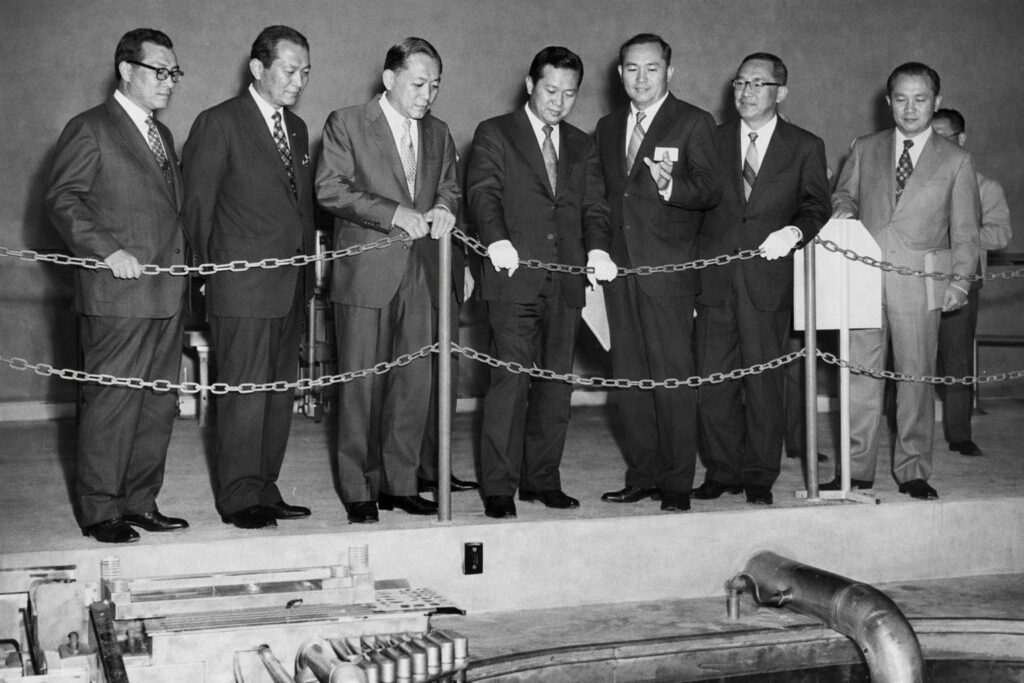
It is important to note, however, that despite the country’s considerable resources, the nuclear programme of that era—known as Project 800—was relatively modest in scale. It consisted of several sub-projects, such as Project 890, which aimed to develop a nuclear warhead design. All of these components depended on one another. At the same time, the programme was managed by only a handful of scientists and engineers and lacked high political priority.⁶ Rather than constituting a full-scale weapons programme, it functioned more as a strategic joker in reserve—an insurance policy to be kept in the back pocket for crisis scenarios in which South Korea might need stronger cards at the negotiating table, particularly if the United States were ever to “optimise” its security commitments in the future.⁷
It is also worth highlighting that if North Korea was aware during the 1990s of South Korea’s uranium-enrichment research—and Pyongyang’s intelligence capabilities in the South should never be underestimated⁴—then South Korean activities may in turn have encouraged North Korea to pursue enrichment capabilities of its own. But why did South Korea seek nuclear weapons in the first place?
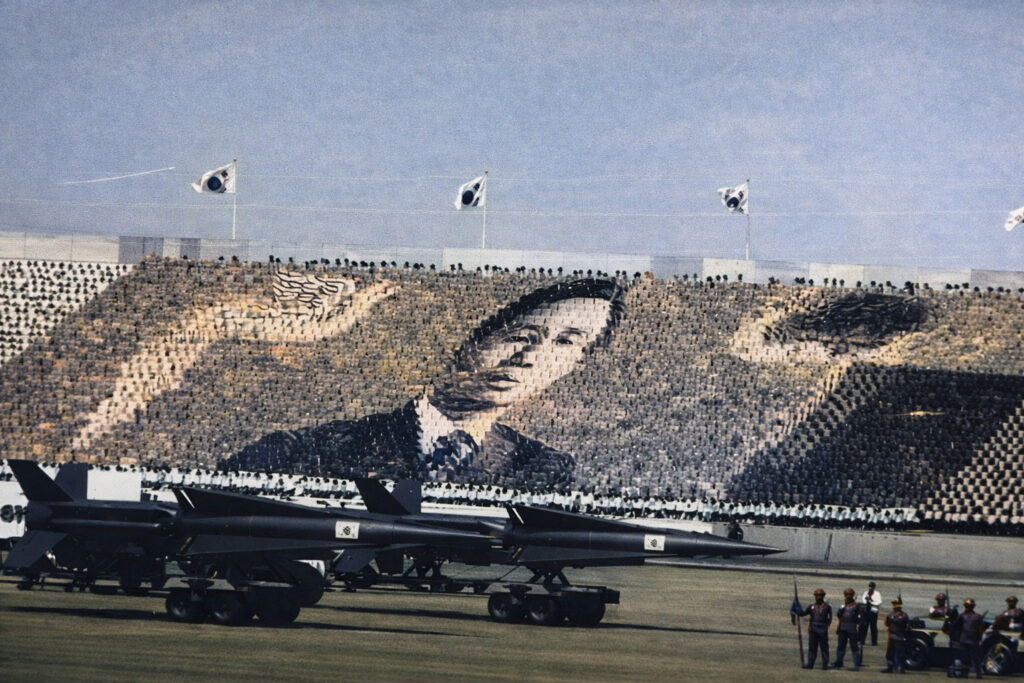
The answer lies in a deteriorating security environment during the late 1960s and early 1970s. Between 1968 and 1972, there were 722 incidents involving North Korea within the Demilitarized Zone (DMZ) and another 294 incidents in rear areas. Several major provocations followed in quick succession: the 1968 attempt to attack the presidential residence, the USS Pueblo incident later that year, and the 1969 shootdown of a U.S. Navy EC-121 reconnaissance aircraft. Fast-forward to the period between 2022 and 2026, and the security environment has once again deteriorated from the perspective of democratic states. North Korea’s accelerating military modernisation is increasingly threatening to outpace the conventional technological advantages upon which South Korea has long relied.
It would be a serious mistake to view the Korean People’s Army (조선인민군) in 2026 as a relic of the previous century—an institution incapable of learning or achieving success on the battlefield. Lessons from the war in Ukraine are being absorbed and brought home, while modern weapons systems are entering mass production. Importantly, such weapons do not need to represent the cutting edge of global military technology. They merely need to be effective enough to accomplish their intended purpose. Better still if they can be produced in quantities large enough to export to partners or offer through barter arrangements—which is precisely what is taking place.
When the United States withdrew all of its nuclear weapons from the Korean Peninsula in 1991, only a small minority of South Koreans supported efforts to pursue nuclear fuel reprocessing. Nevertheless, some voices already urged the government to acquire nuclear weapons, driven by recurring clashes with North Korea.⁸ By contrast, as tensions escalated during the 2017 crisis and concerns grew that Washington might hesitate to defend South Korea for fear of provoking missile strikes against the United States itself, public opinion shifted dramatically in favour of a South Korean nuclear deterrent. Polling indicated that around 60 per cent of South Koreans supported acquiring nuclear weapons.⁹ By 2023, surveys suggested that more than 76 per cent favoured the independent development of a domestic nuclear arsenal.¹⁰
A year later, another survey revealed an important nuance. When respondents were asked, “Do you believe that the United States would employ its nuclear deterrent in a crisis on the Korean Peninsula if doing so created a risk of an attack on the U.S. homeland?”, 60.8 per cent answered “NO.” Although the survey report notes that this should not necessarily be interpreted as declining trust in the United States—and may instead reflect awareness of North Korea’s increasingly advanced nuclear capabilities and more provocative posture—it remains a significant indicator. Support for South Korea’s nuclear ambitions appears to have stabilised at roughly six to seven people out of ten.
This trend is underpinned by two core assumptions. First, that North Korea has effectively become a de facto nuclear state and is unlikely to relinquish its arsenal except through a war that results in regime collapse. Second, that the 47th President of the United States may substantially reduce—or even withdraw—American forces from South Korea, forces that since the end of the Korean War have played a crucial deterrent role against coercion and military pressure from the North.
Green light
Although there are currently no signs that the South Korean government is officially considering the development of nuclear weapons, both the broad public support for such a move and the two Korean-language volumes mentioned above are significant. Together, they show how Seoul is unofficially redefining deterrence and testing the limits of American nuclear guarantees and possible U.S. responses. Like Japan, South Korea possesses the raw materials, technology and resources needed to build nuclear weapons. It has previously been shown that South Korea is capable of enriching uranium up to 77 per cent. Although this level is not particularly suitable for powerful nuclear weapons, it nevertheless indicates that South Korea has the potential to produce weapons-grade, even more highly enriched uranium — and therefore nuclear weapons.
Although South Korea previously did not possess intercontinental ballistic missiles, it has a wide range of short- and medium-range ballistic missiles. On 21 May 2021, the decades-old missile guidelines limiting the range of South Korean ballistic missiles were terminated, allowing South Korea to develop and possess any type of missile, including intercontinental ballistic missiles (ICBMs) and advanced submarine-launched ballistic missiles (SLBMs).¹¹ Accordingly, South Korea announced already in 2022 that it had developed submarine-launched ballistic missiles, such as the Hyunmoo-4-4. Importantly, South Korea is the only country that possesses SLBMs but does not have nuclear weapons.¹² The first steps have also been taken at the political level, especially in February and March 2023, when Chung Jin-suk, leader of the People Power Party (국민의힘), stated that South Korea may need nuclear weapons, and Seoul Mayor Oh Se-hoon called for South Korea to acquire them.¹³
In 2025, a declassified South Korean document confirmed that Russia had offered the country nuclear-programme-related cooperation as a way of settling debt inherited from the Soviet Union. In 1992, Russia offered advanced nuclear technology, including solutions for extending the lifetime of nuclear power plants.¹⁴ In 1994, Russia additionally offered 50 tonnes of highly enriched uranium from Ukrainian nuclear warheads, as well as 150 tonnes of low-enriched uranium annually for ten years.¹⁵ Some would call all of this a chain of coincidences: diplomats meeting by chance, perhaps accidentally complaining about the maintenance costs of surplus nuclear fuel, while someone listening nearby suddenly began to see possibilities. Some coincidences are capricious; they appear where demand, contacts and strategic opportunity already exist.
The Atom’s finest hour
Estonians, too, could be polled endlessly on whether they consider the acquisition of nuclear weapons necessary, and the answer would probably surprise no one except Moscow, where such a desire would, of course, be met with deep offence and shock. But such a desire does not emerge from a vacuum. What is certain is that it always returns when the surrounding environment becomes existentially dangerous and security guarantees are “as reliable as the Budapest Memorandum.” And when interest is strong enough, the world almost always contains actors willing to offer solutions to such concerns.
Yet interest and support for the atom are meaningless without the capability to handle it. This is precisely what separates slogans from real policy: whether one is dealing with a dream or with an actual possibility. This is a fundamental question. It does not concern only the Korean Peninsula, but also haunts Europe, especially its eastern and northern regions, where some nations are technologically and industrially capable—over a longer timeframe and if they were willing to put everything on the table—of imitating Korea. For them, security has long ceased to be an abstract debate. It has become a real-life Squid Game, where everyone knows what happens if, during red light, even a single wrong movement is made.
Remarks
A The project aims to publish four volumes by the end of the first half of 2026, bringing together approximately fifty experts from South Korea and abroad. Contributors include current and former academics, think-tank researchers, former diplomats, retired generals and admirals, government officials and other senior practitioners representing fields as diverse as international relations, international law, regional studies (including North Korea, the United States, China, Japan, Russia and the Middle East), military affairs, nuclear technology, and defence and security studies. More broadly, the project seeks to establish a comprehensive cause-and-effect framework that would allow future governments to pursue nuclearisation gradually and systematically—step by step, without exhausting the economy or excessively alarming the international community. The underlying logic is to prepare the intellectual and political groundwork for a future moment when a brief but consequential announcement may arrive with the force of an earthquake: that the nation’s words and actions are now ultimately backed by the atom.
B North Korea’s primary objective remains regime survival and immunity from external coercion. Its nuclear weapons serve this purpose above all as a deterrent: they raise the cost of outside intervention and provide Pyongyang with considerable strategic freedom of manoeuvre. Yet a logic of survival does not automatically preclude aggression. If circumstances were to become favourable—for example, amid the turmoil of a wider great-power conflict—and South Korea found itself isolated, such conditions could present North Korea with what it might regard as an ideal opportunity to once again attempt “liberation,” this time holding far stronger cards than before. For this reason, it would be unwise to assume that Pyongyang’s ambitions are limited solely to preserving the status quo. The regime’s immediate priority may be survival, but its long-term objectives and historical aspirations should not be dismissed merely because deterrence currently makes them difficult to pursue.
Sources
1 Whyte, L. & Keck, Z., 2017. Can South Korea Build a Nuclear Bomb in 6 Months? The National Interest, 23.09.2017.
2 Jang, H.-W., 2025. 한국핵안보전략포럼 ‘한국의 핵안보 프로젝트’ 1·2권 출간 [Korea Nuclear Security Strategy Forum publishes Vols. 1–2 of “The Korean Nuclear Security Project”]. Skyedaily, 10.08.2025.
3 Hayes, P., 1991. Pacific Powderkeg, American Nuclear Dilemmas in Korea. Lexington Books, pp. 199–208.
4 Kang, J., Hayes, P., Bin, L., Suzuki, T., & Tanter, R., 2005. South Korea’s nuclear surprise. Bulletin of the Atomic Scientists, 61(1), pp. 40–49.
5 Lim, E., 2019. South Korea’s Nuclear Dilemmas. Journal for Peace and Nuclear Disarmament, 2(1), pp. 297–318.
6 Reardon, R. J., 2025. Civilian nuclear technology transfers as nonproliferation leverage: a reexamination of South Korea’s nuclear-weapons program. The Nonproliferation Review, pp. 1–23.
7 Cha, V. D., 1999. Alignment despite Antagonism: The United States–Korea–Japan Security Triangle. Stanford, CA: Stanford University Press, pp. 123–125.
8 Mack, A. 1997. Potential, not proliferation: Northeast Asia has several nuclear-capable countries, but only China has built weapons. Bulletin of the Atomic Scientists, 10.01.1997.
9 Sanger, D. E., Choe, S. & Rich, M., 2017. North Korea Rouses Neighbors to Reconsider Nuclear Weapons. New York Times, 28.10.2017.
10 Jung, M., 2023. Over 76% of South Koreans support development of nuclear weapons. The Korean Times, 30.01.2023.
11 Seok-min, O. 2021. (News Focus) Lifting of U.S. missile restrictions signifies Seoul’s missile sovereignty, Washington’s China strategy: Experts. Yonhap News Agency, 21.05.2021.
12 Sang-Hun, C., 2023. In a First, South Korea Declares Nuclear Weapons a Policy Option. The New York Times, 12.01.2023.
13 Shin, H., 2023. Exclusive: Seoul mayor calls for South Korean nuclear weapons to counter threat from North. Reuters, 13.03.2023.
14 노, 민호., 2025. 러시아, 韓에 우크라 핵탄두서 추출 고농축 우라늄 50톤 판매 제의 [Russia offers to sell South Korea 50 tons of highly enriched uranium extracted from Ukrainian nuclear warheads]. 파이낸셜뉴스, 28.03.2025.
15 서, 주희., 2025. 러시아, 30년 전 韓에 우크라 핵탄두서 추출된 우라늄 판매 제안 [Russia offered to sell uranium extracted from Ukrainian nuclear warheads to South Korea 30 years ago]. 채널A, 28.03.2025.
Jaga postitust: