
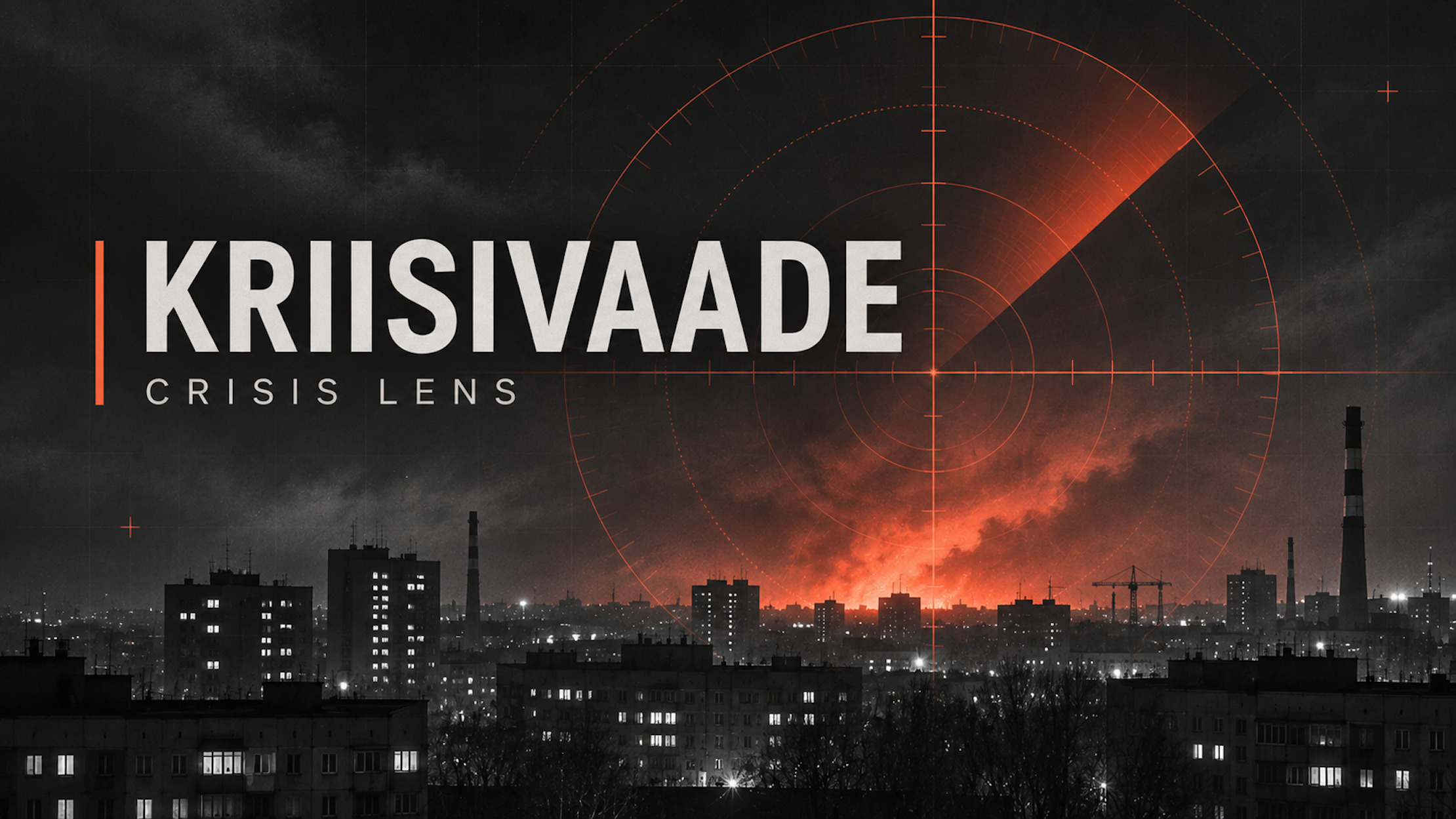
Crisis Research Centre Launches New Analytical Series Crisis Lens
Developments in the international security environment are increasingly intertwined with the internal functioning of states, societal resilience and the everyday safety of citizens. Military conflicts are not confined to battlefields, and the consequences of geopolitical decisions can be felt thousands of kilometres away from conflict zones. Crisis Lens is founded on the understanding that making sense of these processes requires the simultaneous examination of political, military, economic and societal factors.
Crises from the Perspectives of the Aggressor, the Defender and Civil Society
One of the guiding principles of the series is to examine crises from the perspectives of different actors. In the context of military conflicts, this involves analysing the aggressor’s strategic objectives and behaviour, the defender’s choices and capacity for adaptation, and the consequences for civil society. Examining different perspectives does not imply equating the moral or legal responsibilities of the parties involved, but rather helps to develop a better understanding of the factors shaping their actions.
Particular attention is devoted to realpolitik, the strategic interests of states, the relationship between military and political capabilities, and the role of international institutions in crises. Equally important is understanding how decisions taken at the national level affect the ability of local authorities, communities and individuals to cope with crises, and what lessons can be drawn from these experiences to strengthen crisis preparedness and civil protection in Estonia.
In-Depth Analyses and Research-Based Insights
Unlike conventional news reports and opinion pieces, Crisis Lens articles are structured as extended, source-based analyses and research-oriented insights. Their approach resembles that of small-scale research studies, drawing on specialist literature, historical sources, documents, statistical data and analyses by other experts. The purpose of these articles is not merely to comment on current developments, but to explore their historical and institutional background, identify the factors shaping them and analyse their potential consequences. Where appropriate, the articles incorporate historical parallels, comparisons between countries and conflicts, maps and other visual materials supporting the analysis.
Crisis Lens thus occupies the intersection between academic research and analytical journalism aimed at the wider public. Whilst the series does not replace peer-reviewed academic publications, it applies the critical evaluation of sources and reasoned argumentation characteristic of academic research in a manner that makes complex specialist issues accessible to a broader readership.
Bringing Together Expertise from Different Fields
The driving force and principal author behind Crisis Lens is Hannes Nagel, Head of the Crisis Research Centre and a researcher whose professional work focuses on crisis management, public sector decision-making during crises and civil protection. His analytical approach is characterised by integrating these fields with questions of geopolitics, military history, military affairs and international security.
Nagel’s analyses frequently focus on the relationship between formally declared capabilities and actual operational capacity, institutional behaviour during crises, and the relevance of historical experience to understanding contemporary security and crisis management challenges. This interdisciplinary approach enables military and geopolitical developments to be examined beyond their immediate security policy context, paying particular attention to their societal, institutional and human consequences. The series provides an opportunity to address issues that often fall between traditional fields of analysis but are essential to developing a comprehensive understanding of crises.
From Historical Experience to Future Crises
One of the key premises underpinning Crisis Lens is that learning from crises need not begin only after they have ended. Analysing events that have occurred in other countries and during earlier historical periods makes it possible to identify warning signs, assess the effectiveness of existing systems and explore potential future scenarios before they materialise. The series thereby contributes to the dissemination of crisis management knowledge, encourages more informed public debate and promotes a mindset centred on crisis prevention. Crisis Lens is intended both for professionals working in crisis management, security and civil protection and for anyone seeking a deeper understanding of international developments and their implications for Estonia.
Crisis Lens articles will be published on the Crisis Research Centre’s website at least three to four times a year. Additional analyses will be published in response to international developments, the relevance of particular topics and specific commissions. We hope you enjoy reading the series!
🟠 All articles in the series can be found on the Crisis Research Centre’s website under the keyword Crisis Lens. Photo: The Crisis Research Centre’s Crisis Lens analytical series (Crisis Research Centre, 2022).
🔺The use, distribution, modification or publication of text and images is permitted only with the prior written consent of the NGO Crisis Research Centre. Any unauthorised use is strictly prohibited.
Jaga postitust: