
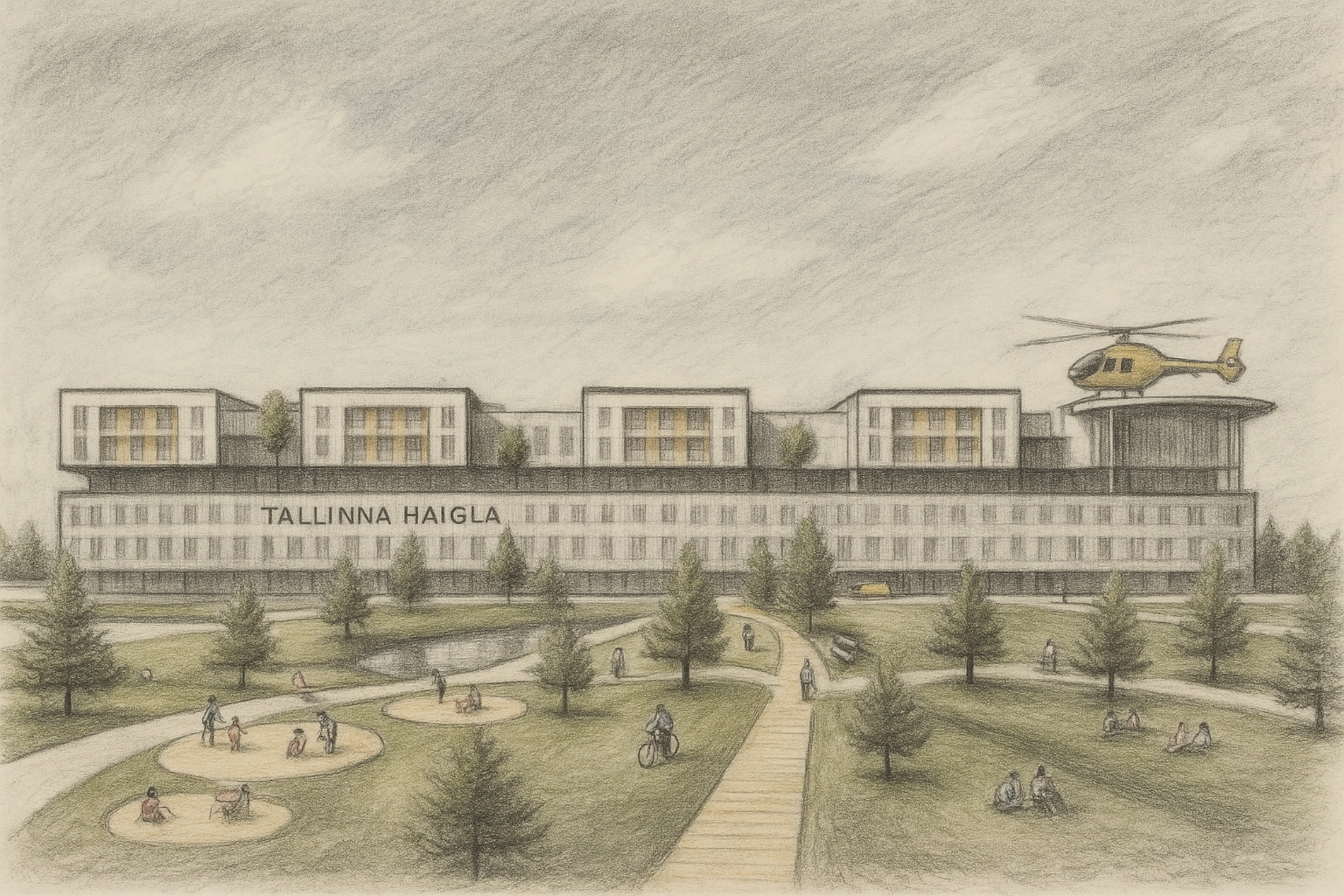
Tallinn Hospital would be a strategic target for Russia
The time is past when attacking civilian facilities marked with a red cross was considered taboo and condemned. Ukraine’s experience shows that living next to a neighbour like Russia means that hospital planning must also take into account the protection of civilian infrastructure. The planned Tallinn Hospital is no exception.
In short: after February, 24 it is unthinkable to put all our eggs in one basket and place that basket on a potential front line — in the defense of Greater Tallinn, key urban battles would take place precisely in the area of this planned colossus in Lasnamäe.
These issues must be discussed specifically in peacetime, even despite the fact that NATO is increasingly directing its capabilities and deterrence posture toward our region. This is, of course, essential, but the planning of strategic civilian infrastructure is our own responsibility, and if we fail at it, we will face very serious problems in the event of a military crisis.
Namely, from the perspective of comprehensive national defense, the question inevitably arises as to what would happen to Tallinn Hospital in the event of a Russian attack.
We know that in Ukraine the targeting of hospitals and other civilian facilities (such as kindergartens, power plants, shopping centres, public transport hubs, etc.) is a deliberate and strategic objective of the aggressor — all with the aim of terrorising the population and breaking their will and ability to defend themselves.
There is no reason to assume that things would go differently in Tallinn. Quite the opposite — what is happening in Ukraine is likely the very strategy that a hostile neighbour would use against other neighbours as soon as the opportunity arises. The Estonian Defence League has repeatedly spoken about the 3T defence model, in which the roles of the operator, the enabler, and the actor all matter.
If a hospital no longer exists due to missile strikes or bombing, it cannot provide help or support to anyone — unless it becomes a new Azovstal, performing miracles against all odds. Another fact is that Tallinn does need a hospital, but it should be developed as a strategically dispersed campus. Forcing the hospital project forward in its current form simply makes no sense. It is also a fact that the hospital was planned for a world that no longer exists. The original project did not even foresee the existence of (bomb) shelters, let alone take into account the possibility of carpet bombing.
Another fact is that Tallinn does need a hospital, but it must be developed as a strategically dispersed campus. Only then can it fulfil the roles of an enabler and an actor. Forcing the hospital project forward in its current form simply is not rational, regardless of how many millions were spent on designing Tallinn Hospital before February 24.
We have reached a point where the Ministry of Defence must be involved in the coordination process of strategic infrastructure projects. More than 445,000 people live in Tallinn — in some city districts more than in entire major cities elsewhere. All of them need access to modern medical care, but not in the form of a mammoth hospital — neither in peacetime and certainly not in wartime. There is no going back to the old way of thinking.
The op-ed (Hannes Nagel) was published in the print edition of Postimees on 4 July (No. 126 (7769), p. 10).
Jaga postitust: