

2026 Fuel Crisis | How the shock of the Strait of Hormuz affected daily life in Australia
Australia’s 2026 fuel crisis clearly shows how a geopolitical conflict taking place far away can, within a short period of time, become a very ordinary problem: more expensive refuelling, higher grocery prices, uncertainty in peripheral regions, pressure on the transport and agriculture sectors, and a political debate over how much fuel the state itself should be able to stockpile.
Australia’s spring 2026 fuel crisis is not only a question of how much petrol costs at service stations in Perth, Sydney, or Melbourne. It is a broader test of crisis preparedness, bringing together price increases, supply security, public trust, regional inequality, and the country’s dependence on imported liquid fuels. On the one hand, it is a price crisis, because rising fuel prices quickly feed into everyday household costs. On the other hand, it is a matter of national fuel security pressure and local supply disruptions, rather than a nationwide exhaustion of fuel. Third, it is a crisis of trust: when people fear that fuel may run out, they buy more than usual, and this can create local shortages even before national stock levels have actually fallen to a critical point.1,2
From geopolitical shock to everyday price pressure
Australia’s example is important from the perspective of crisis studies because it shows how a geopolitical event taking place far away can very quickly become an ordinary and local problem. The Strait of Hormuz is not an everyday reference point for Australian households, but in spring 2026, instability in the region became visible in fuel prices, food supply chains, road transport, regional air connections, and the political debate over how much fuel the state should be able to secure on its own. A fuel crisis is therefore not only an energy policy issue, but a test of how well a society understands its dependencies before they become visible in a crisis.
The root cause of the crisis lies far from Australia. The war in the Middle East and the uncertainty around the Strait of Hormuz have unsettled energy and shipping markets. For Australia, the problem is particularly acute because the country’s liquid fuel supply chain is long, import-dependent, and linked to Asian refining centres. Australia does not depend only on the price of crude oil, but also on the availability of refined petrol, diesel, and aviation fuel, shipping routes, exchange rates, terminal costs, taxes, and retail margins. As a result, a disruption in the global energy market can reach Australian consumers even if fuel does not physically disappear from the country. The impact appears first in prices, then in supply-chain pressure, and finally in people’s behaviour.
Australia’s vulnerability does not stem only from the fact that fuel comes from far away. It also stems from how Australian society and the economy function. The country is very large, settlement is uneven, and many forms of life and economic activity require long distances. Mines, agriculture, road transport, regional air connections, ports, refrigerated food supply chains, and remote communities all need fuel every day. In some densely populated European countries, rising fuel prices may primarily mean more expensive car travel. In regional Western Australia, however, they can mean direct access to work, healthcare, school, food, and business activity. This is precisely why a fuel crisis cannot be assessed only by the price per litre. The question is also whose mobility, services, and income come under pressure first through that price.


Crisis management before empty petrol stations
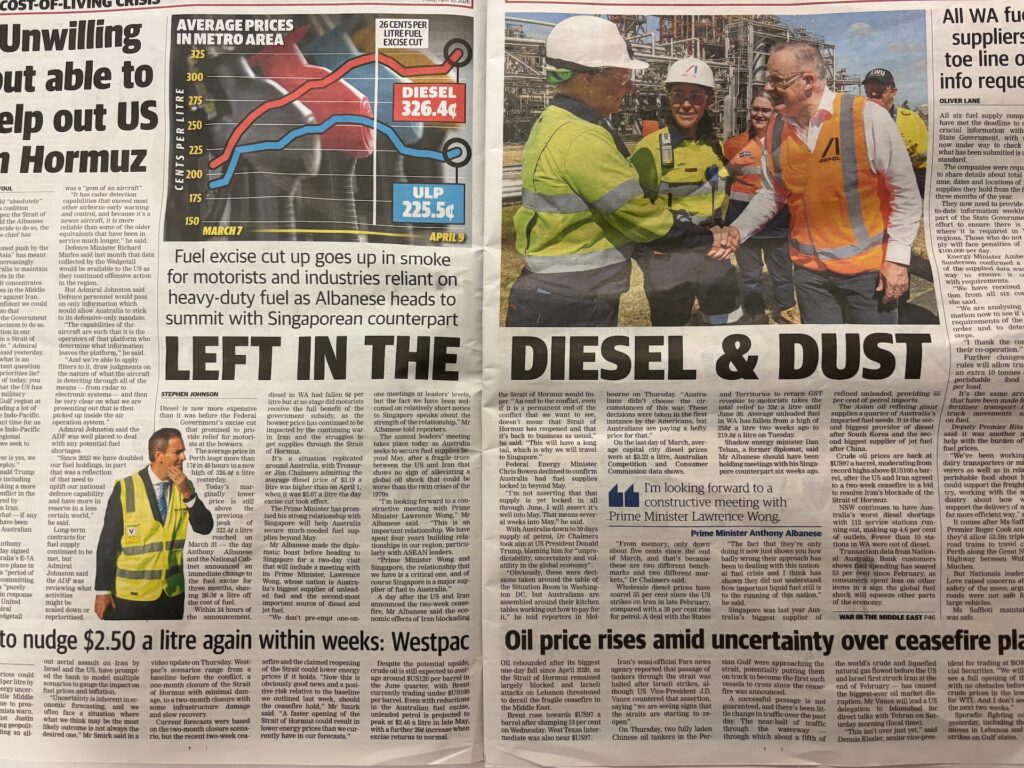
In late March and early April, the crisis became increasingly visible politically in Australia. From April 1, the federal government reduced the fuel excise by 26.3 cents per litre for three months and also reduced the road user charge for heavy vehicles for the same period. The aim of the measure was to ease price pressure on households and the transport sector at a time when the international fuel shock had already begun to reach the Australian market.³ The excise cut was a quick and politically understandable step, but it did not address the cause of the crisis. Tax relief may reduce the price at the pump, but it does not create additional fuel, shorten supply chains, or reduce the country’s dependence on imported liquid fuels. In other words, it helps to soften the symptoms, but it does not remove the systemic vulnerability.
Australia’s national response was based on a four-level fuel security plan. Its aim was to keep the country moving even in a situation where the international fuel market was unstable. The four levels of the plan were: plan and prepare, keep Australia moving, apply targeted measures, and protect critical services. In the early phase of the crisis, all states and territories, including Western Australia, were at the second level of the plan. This meant that fuel was still available at the national level, but governments were taking precautionary measures, monitoring the market, and urging people to buy only the amount of fuel they needed.⁴
This four-level logic is important because crisis management does not begin only when fuel has run out. It begins earlier, when the system is still functioning but already needs to be actively managed. If a state waits until petrol stations are empty on a large scale and critical sectors start competing with ordinary consumers, the room for manoeuvre is much smaller. Australia’s situation illustrates precisely this grey area: the country is not in full deficit, but normal market-based logic may no longer be sufficient to ensure reliable, even, and fair supply.
Diesel as the real nervous system of the crisis
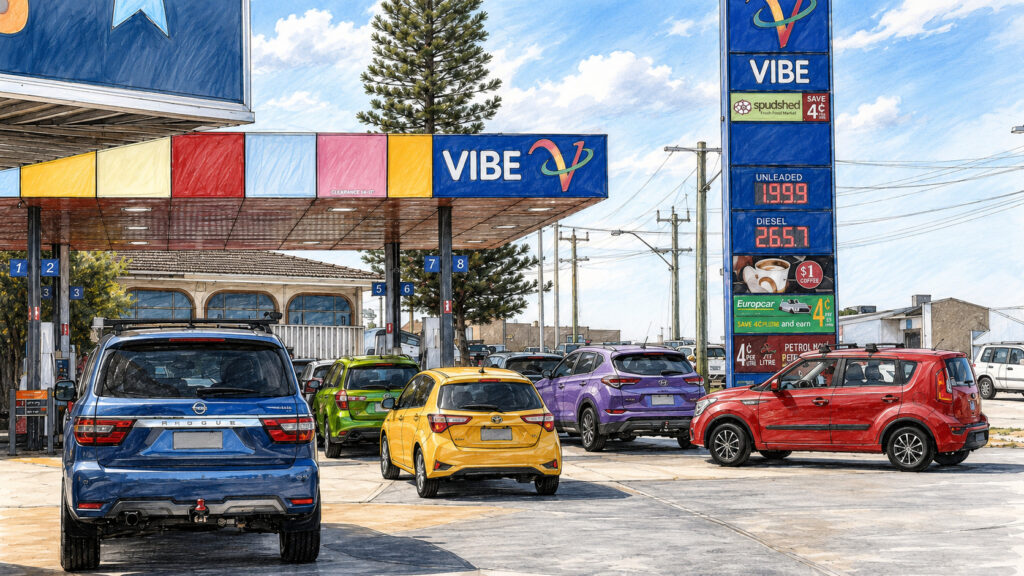
Diesel has a particular significance in this crisis. Petrol directly affects many households and everyday car use, but diesel keeps much of Australia’s economic metabolism running. It is needed for freight transport, agriculture, mining, construction, regional services, and parts of critical infrastructure. By early April, the price of diesel had risen very sharply again, even though the fuel excise had been cut. The reason is that demand for diesel is much less flexible than demand for ordinary petrol: people can reduce weekend trips, but food, goods, construction materials, and mining inputs still need to be transported.⁵
As a result, a diesel crisis quickly feeds through into transport costs, food prices, agriculture, construction, retail, and the functioning of regional services. When diesel becomes more expensive or harder to access, the issue is not only the cost of filling one truck’s tank. The question is how much more expensive it becomes to move food from farm to shop, how much pressure small freight operators come under, and when businesses begin passing additional costs on to consumers.
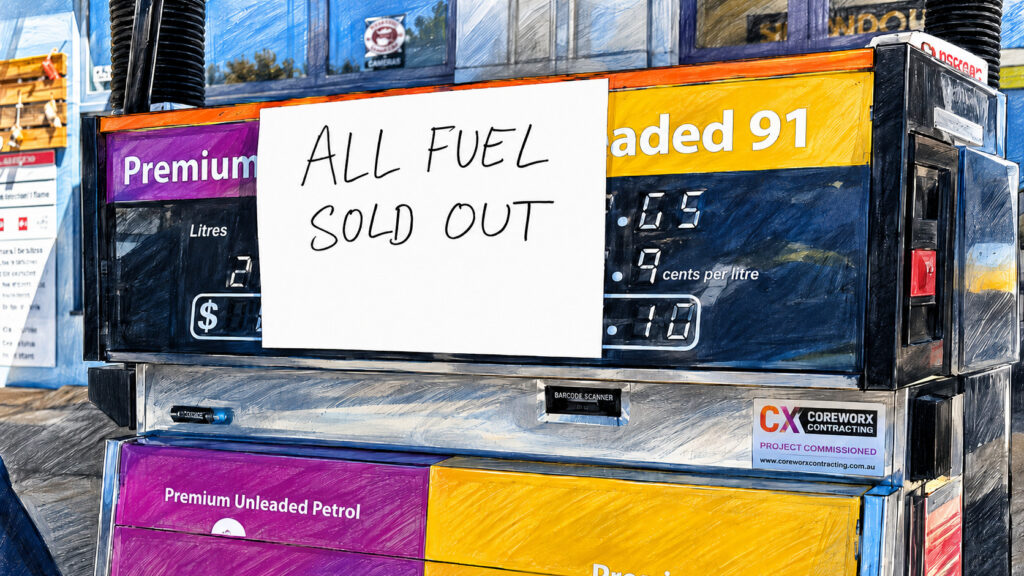
The crisis was particularly visible in Western Australia, where vast geography, regional dependence, the mining economy, and practical supply-chain constraints intersect. In early April, FuelWatch data showed that several service stations in Western Australia were without one or more fuel types. As of April 3, 16 service stations in the state had neither diesel nor petrol, 29 had no petrol, and 33 had no diesel.² This does not mean that the entire state was without fuel. It does show, however, how an international supply shock can become a local access problem: in one area fuel is available, in another it is temporarily unavailable, in a third only some fuel types are available, and in a fourth the main problem is price.
This is where the regional inequality of crises becomes visible. Perth may experience the fuel crisis as higher prices, constant checking of fuel apps, and inconvenience, but in more remote parts of Western Australia the same crisis can mean a practical risk of service disruption. When the nearest petrol station is far away, there are fewer alternative suppliers, and public transport is absent or very limited, fuel is not simply a consumer good. It is a condition of access. From a preparedness perspective, this means that the same national level of supply can translate into very different local realities.
For the Western Australian government, FuelWatch became not only a price comparison tool during the crisis, but also a crisis management instrument. In early April, it was decided that from 1 May the FuelWatch reporting obligation would be extended to all fuel retailers in the state, adding around 200 additional regional retailers to the system. Penalties for breaching reporting requirements were also increased, and the system was emphasised as a way to help consumers find cheaper fuel and help the state see more clearly where fuel shortages were emerging.⁶ In a crisis, information is not a side issue. If decision-makers do not know precisely enough where fuel is located, where it is moving, and where the first disruptions are emerging, crisis management becomes guesswork.
The crisis also forced Western Australia to deal with very practical logistical questions. On April 7, decisions were made to support the transport and aviation sectors: regional airfare caps were to be maintained, part of the fuel costs for critical regional flights was to be covered, and the use of larger road trains was expanded to reduce the number of truck movements and improve the movement of goods to regional areas.⁷ On April 9, an additional measure allowed accredited trucks, road trains, and milk tankers to carry up to 10 tonnes more milk and perishable goods per trip under certain conditions.⁸ These examples show that a fuel crisis is simultaneously an issue of energy, food, transport, agriculture, regional policy, and social policy.
It is important to be precise about sales restrictions. Australia has not introduced a nationwide general refuelling limit or a single uniform sales restriction applying to all drivers. However, the possibility of rationing has been discussed, and the national plan allows for fuel to be directed to critical sectors in the worst-case scenario. The public has not been given one precise date or threshold for when rationing would be introduced, because the government has to maintain trust, avoid panic, and prepare for possible supply disruptions at the same time.¹ This is a classic crisis communication dilemma: too much ambiguity can undermine trust, but too specific a warning can trigger panic buying.
A fuel crisis affects people very differently. A higher-income person living in a city, who can work from home or has an electric vehicle, experiences the crisis differently from a regional worker, a young trainee, a small business owner, a carer, or someone whose ability to get to work depends on daily car use. In such cases, rising fuel prices are not an abstract inflation indicator. They become a question of whether commuting to work is still worthwhile, whether a child can get to school, whether an older person can reach a doctor, and whether a small business model remains viable at all.
By mid-April, the Australian debate had reached a point where the need for short-term measures was clear, but their limits were equally visible. The fuel excise cut reduces prices, but not dependency, and FuelWatch improves visibility, but does not create additional fuel. Higher vehicle load limits may reduce the number of trips, but they do not remove logistical vulnerability. Rationing plans give the state a tool for the worst-case scenario, but their use would already indicate that normal market-based distribution is no longer functioning sufficiently. The central significance of the crisis is therefore that it has exposed the dependency of the liquid fuel system, regional inequality, and the need for decision-makers to gain a much clearer view of the supply chain.
The most important lesson is that fuel security cannot be treated only as a technical calculation of reserve days. Reserves are necessary, but the crisis shows that transparent information, distribution capacity, an understanding of regional differences, public trust, and long-term dependency reduction are just as important. When fuel is simultaneously an input for the economy, a condition for everyday mobility, and a prerequisite for critical services, a fuel crisis is never only a fuel crisis. It is a test of how well a society understands its own vulnerabilities before they become fully visible.
The existence of fuel reserves does not yet mean crisis resilience.
Lesson for Estonia: reserves alone are not enough
Estonia can learn from Australia’s fuel crisis precisely because the two contexts are different, while the underlying crisis logic is similar. Estonia is not the size of Western Australia and its distances are shorter, but liquid fuel is also a critical input for transport, rescue services, the police, ambulance services, food logistics, agriculture, local services, and people’s everyday coping. When the price or availability of fuel comes under pressure, the impact does not remain at the petrol station. It moves on into services, prices, and people’s sense of security.
Reserves must be linked to distribution, information, and trust. Although Estonia has a certain level of fuel reserves and their maintenance is regulated by law, which forms an important basis for preparedness, the decisive issue in a crisis is not only the size of the reserve but also its usability: how fuel reaches petrol stations and critical services, which sectors receive it first, and how panic buying is prevented. An up-to-date overview of commercial stocks, distribution capacity, and local disruptions is equally important. If the public is only told that “reserves exist” without an explanation of what this means in practice, rumours, queues at petrol stations, and social media will fill the information gap. Fuel reserves must therefore be accompanied by clear communication: whether petrol stations will remain open, when the state will intervene, which services will be prioritised, and what ordinary people should do in different phases of the crisis.
A crisis plan must distinguish between different fuel types and local-level needs. A fuel crisis cannot be planned for using only the general term “fuel”. Petrol, diesel, and aviation fuel play different roles in society. Petrol directly affects many people’s everyday mobility, but diesel is critical for freight transport, agriculture, heavy machinery, waste management, generators, construction, and food logistics. This also directly affects local governments, even though they do not manage the fuel market. Social transport, home care services, school transport, the work of crisis committees, the opening of evacuation sites, the operation of generators, and assistance to residents all require access to fuel even when the market is under pressure. Crisis plans should therefore answer not only how much fuel is in reserve, but also what different fuel types are needed for, by whom, and in what order of priority during a crisis.
A fuel crisis is also a question of social vulnerability and reducing dependency. A fuel shock does not affect everyone equally. Some people can work from home, reduce trips, or use alternative transport. Others do not have that option. A person living in a rural area, a family with care responsibilities, a lower-income worker, or a small business owner may come under pressure much faster than someone whose mobility needs are more flexible. In the longer term, Australia’s experience shows that fuel reserves are necessary, but they cannot be the only answer. If critical services, the movement of goods, and everyday life remain heavily dependent on liquid fuels, every global energy market shock remains potentially dangerous. For Estonia, this means that fuel security must be discussed alongside demand reduction, alternative modes of transport, electrification, the continuity of local services, and the diversification of critical supply chains.
Australia’s experience shows that a fuel crisis is not solved only when fuel is already scarce. It is addressed earlier: through data, distribution plans, reliable communication, local preparedness, and a realistic understanding of what society actually depends on.
Photos: Crisis Research Centre in Australia and fuel crisis illustrations (KRUK, 2026).
Sources
Jaga postitust: