
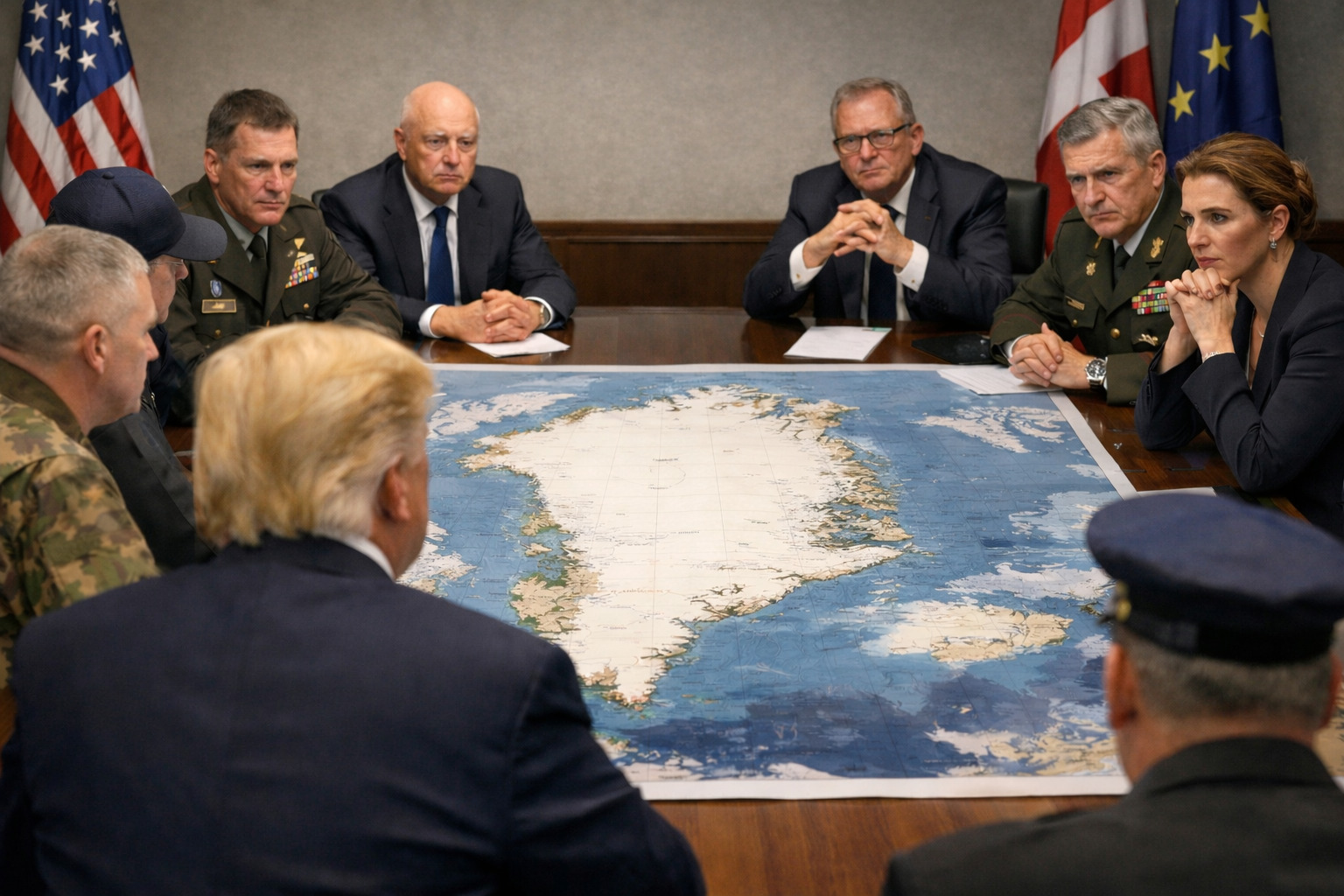
NATO in the Greenland fog
The Greenland tension¹ now gathering around the world’s largest island is not, in itself, the greatest danger—nor is it the first source of discord among NATO countries. What is newly dangerous instead is a crisis of definitions: whether we can still, together, call things by their proper names and draw the necessary conclusions from that naming. This matters because conflicts are not won only by seizing territory, but also by seizing the language and the mindset through which we make decisions.
First, when considering the broader possible consequences of the Greenland case, it should be recalled that NATO is a military-political organization, with the emphasis on “political.” This means that without political-level consent, the military side of the organization will not function. It should also be noted that internal disputes among NATO countries are nothing new under the sun. They have happened before.
Throughout NATO’s history, the closest example of an intra-alliance conflict hotspot has been the clash of interests between Greece and Turkey over Cyprus. Although both countries joined NATO in 1952, their shared membership did not resolve centuries of enmity or its expressions between the two nations. On several occasions, the countries have been on the brink of confrontation, mostly due to the island of Cyprus and the Greek archipelago in the Aegean Sea. The events of 1974 in Cyprus led to the creation of the quasi-state known as the Turkish Republic of Northern Cyprus. In that situation, Greek interests were violated—interests that Athens regards as part of its cultural sphere.
An important distinction, however, is that the conflict took place in Cyprus, which is not part of NATO territory and is not covered by NATO’s collective defense. Therefore, Greece, for example, could not initiate consultations or invoke various articles.
The Greenland case
Half a century later, on another island—this time much larger and richer in natural resources—a new apple of discord is ripening between NATO member states, one that may ultimately find an analogous resolution without the application of collective defense. What would the situation look like if one member state were to request consultations under Article 4 in relation to another? In the case of Greenland, Denmark does not need permission to raise the issue within NATO or to request assistance—consultations and political pressure are possible in any case (Article 4).
At the same time, invoking Article 4 does not entail any collective defense obligations. However, when it comes to NATO’s collective defense decisions (Article 5), these are made by consensus, which means that such a decision essentially requires the absence of objections from all members. If the crisis were triggered by a NATO member itself, it could easily block such a decision—and this is precisely why the dispute over definitions (whether something constitutes an “armed attack” or “not an attack”) becomes even more significant and dangerous: it could leave Denmark, instead of relying on a formal Article 5 path, dependent on bilateral steps and ad hoc coalitions by allies, rather than on the alliance’s automatic reflex.⁴
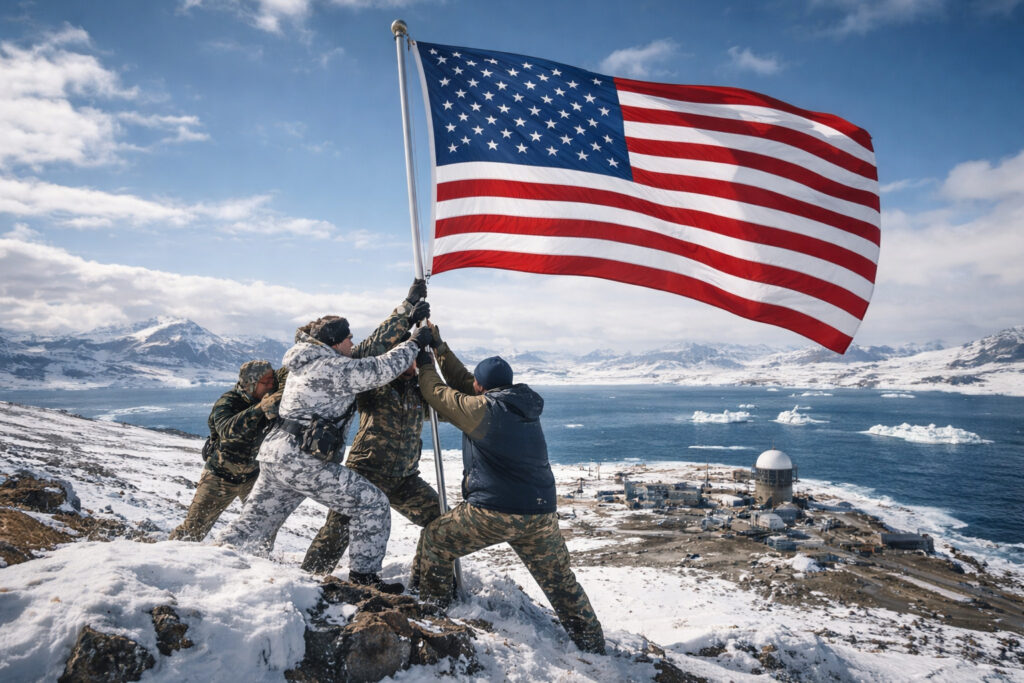
It is certain that in such consultations there would also be a dispute over what actually happened. Collective defense sounds simple as a principle: an attack on one is an attack on all. But before that principle can begin to work politically, one must also pass a lesser-known milestone alongside Articles 4 and 5—namely Article 6. It defines what counts as an “armed attack” and to which territories that logic extends.² Greenland fits into this framework geographically: it lies in the North Atlantic, north of the Tropic of Cancer, to which the principle of collective defense should apply. Yet the concern is not necessarily that Article 6 does not apply, but that enough dispute can be stirred around it to render its application practically useless.
A crisis of definitions always begins the same way: something serious happens in reality, but softer names are offered for it in language. Pressure becomes negotiation, blockade becomes a safety zone, violence becomes the restoration of order, and conquest sometimes becomes the safeguarding of national security. Meanwhile, an attack may turn into a statement that “we are not at war”³—or, at most, a limited and temporary military operation “beneficial to all.” If the renaming succeeds, the reaction changes as well. Not because states are incapable of reacting, but because they can no longer agree on what exactly they are reacting to.
The greatest danger, therefore, is not that a classic takeover will occur in Greenland, awakening Europe in shock. The greater risk is the opposite: that there will be no clear moment to point to in retrospect. Instead, there would be a sequence of steps eventually leading to the curtailment of autonomy and possible state integration. If such a course were taken, the entire crisis would be built around the threshold of Article 6: whether the event qualifies as an “armed attack,” what constitutes an attack, who was armed (if anyone), and, more broadly, whether anything at all happened.
This would inevitably become a tool for NATO-hostile actors to undermine allied unity. If the allies spend the first week debating “what and whether something happened,” the second week debating “how and whether to respond,” and the third week debating whether the response is proportional and consistent with realpolitik realities, the facts on the ground may already have solidified.
NATO’s strength lies in unity
NATO’s strength is not only in its military capabilities but in its unified perceptual framework: that the same thing is seen and named the same way. The crisis of definitions thus breaks alliances on two levels simultaneously. On one level is the public: if people are repeatedly told that “this is not a hostile act,” their willingness to respond diminishes. On another level are the allies: if some call an event an attack while others label it an “incident” or a “crisis,” a shared understanding disappears—and without a shared understanding, no shared response can follow.
Therefore, the most important question is not whether Article 6 “covers” Greenland. The most important question is whether the political system would be able to name the power pressure that arises in reality as an attack within the meaning of Article 6—before the situation becomes irreversible. If it cannot, the result is a precedent in which rules do not break when someone forcefully violates them, but when people begin to argue about whether breaking the rules can even be called breaking.
This is dangerous for militarily weaker small states, because their security depends on one simple mechanism: that an attack is recognized as an attack quickly and collectively. If that mechanism is replaced by a prolonged argument over interpretation, then there is trouble. The adversary no longer needs to believe we are unable to respond; it is enough for him to believe we would be unable to agree.
The Greenland tension may therefore turn out to be a litmus test not only for how the Arctic is approached but also for whether the democratic Western world can, in the gray phase of the 21st century, preserve one old skill: to give phenomena a clear definition and an appropriate reaction. If that skill is forgotten, then “everything” will not collapse with one great bang, as the Danish Prime Minister predicted.⁵ It will instead dissolve in the winds of doubt. Doubts, in turn, transform into silence. And silence is precisely what new borders and a new world are built upon.
What can Denmark do?
Denmark’s own politico-military options cannot be ignored: for decades, it has lived comfortably under the assumption that Arctic security is “covered” by the alliance and by the proximity of the United States—but that situation has now changed. Denmark’s own credible, visible, and rapidly deployable military capability in and around Greenland has so far been marginal, and this feeds and sells the argument in Washington that Greenland is a matter of “national security” that the U.S. must ensure if necessary.⁶ Yet this narrative is neither new nor born within NATO itself: the debate over Greenland’s strategic value has been held in the United States since the 19th century, and the Cold War only amplified its resonance.¹
The possible solution is somewhat ironic: if Denmark wants to defuse and de-escalate this crisis in a mutually beneficial way—and to neutralize the growing U.S. concern about the national security vacuum perceived from Greenland—it will not suffice to rely merely on value-based rhetoric or the inertia of welfare-state arguments. It must decisively rebuild and expand Denmark’s own credible and visible Arctic-based military capability so that presence, surveillance, response readiness, and the ability to operate jointly with allies are genuinely perceivable.⁷
Danish defense policy itself has stated that the kingdom bears a special responsibility for the defense of the Arctic and the North Atlantic and has pledged to strengthen its capabilities there; the question now is whether that can be achieved. This is one possible solution that would, in fact, strengthen Denmark’s (and thereby Europe’s) national security both on ice and at sea. A more likely scenario, however, is that the ambitions voiced across the ocean will have to be taken seriously—and that the first confrontation will have to be fought not on the ground, but in the crisis of definitions.
Sources:
🟠 The opinion piece (by Hannes Nagel) was first published in the Delfi opinion portal on January 6. Photoes: image collages from the Greenland tensions (Kriisiuuringute Keskus, 2026).
1 Nagel, H., 2025. Gröönipingega 52. osariik. Kaitse Kodu!, 4, 44−49.
2 (Anon.), 1949. The North Atlantic Treaty. 04.04.1949, NATO.
3 O’Connell, O., 2026. Rubio says US not at war with Venezuela, as Maduro set to appear in New York court on Monday. 03.01.2026, BBC.
4 Facio, F., 2025. What happens if Trump invades Greenland? Brexit Institute.
5 Laugen, L., 2026. Taani peaminister: kui USA ründab teist NATO riiki, lõpeb kõik. 06.01.2026, Delfi.
6 Mackintosh, T., 2026. ‘We need Greenland’: Trump repeats threat to annex Danish territory. 05.01.2026, BBC.
7 (Anon.), 2025. Danish intelligence report warns of US military threat under Trump. 12.12.2025, The Associated Press.
Jaga postitust: